
Edging, Coating, Tempering: How a Raw Sheet Comes of Age as PV Glass
In brief
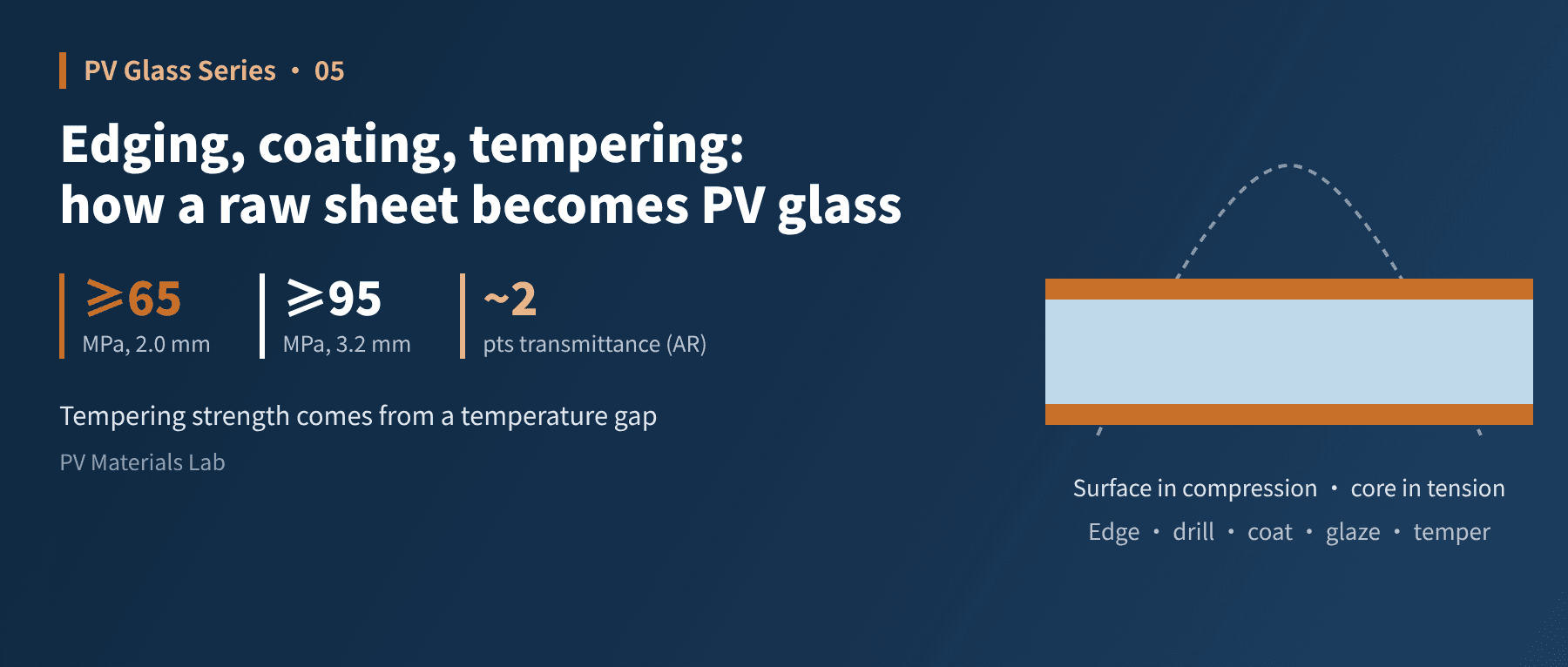
A raw sheet cannot be used in a module as it is. It has to be edged, drilled, coated, glazed and tempered before it becomes qualified PV glass. This article walks along the processing line: why the edge is the weakest part of the glass, how an AR coating raises transmittance through "destructive interference", how tempering "pre-stresses" the glass, and why 2.0 mm glass can only be heat-strengthened.
In the previous article, the batch passed through the furnace and the rollers and became a raw sheet. But the raw sheet is not strong enough, its edges are rough and its transmittance can still be improved, so it cannot go into a module yet. The processing that follows is the raw sheet's "coming of age": grinding off the sharp edges, applying coatings, and a few seconds of rapid quenching before it truly becomes PV glass.
01The processing line: front and rear branches
The main line of processing is "edging – cleaning – surface treatment – tempering – inspection". Front and rear glass differ mainly in surface treatment: front glass receives an AR coating, while rear glass is drilled and glazed.
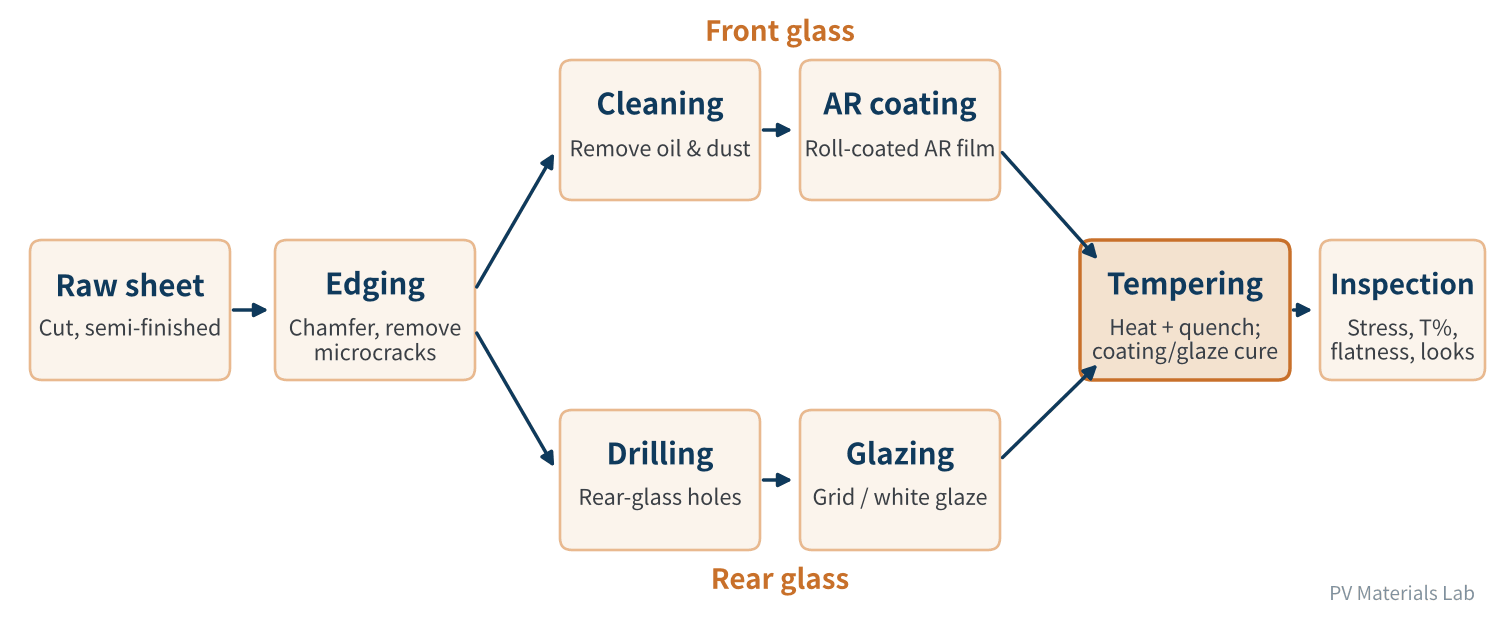
Figure 1. PV glass processing flow
There is one iron rule: all mechanical processing must be finished before tempering. Tempered glass stores a great deal of internal stress; once it is cut or drilled, the stress balance is broken and the whole sheet shatters instantly. Dimensions, holes and edges must therefore all be done right before tempering.
02Edging and drilling: the edge is the weakest part
Almost all glass fractures start at a flaw, and the edge is exactly where flaws concentrate. A freshly cut edge has sharp corners, chips and microcracks invisible to the eye; under load they become crack sources, and they also make the sheet prone to shattering in the tempering furnace.
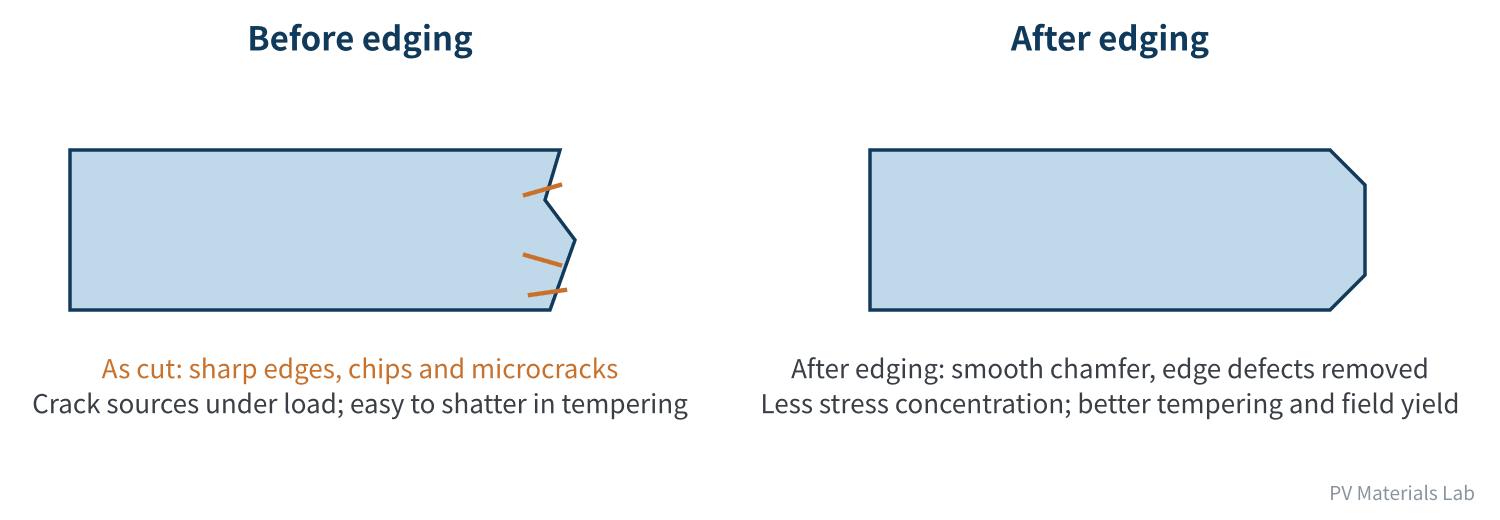
Figure 2. Glass edge before and after edging (schematic)
Edging uses grinding wheels to give the edge a smooth chamfer and remove these flaws. It looks like a simple step, but edge quality directly affects tempering yield and the module's resistance to breakage. In failure analysis of field breakage in glass-glass modules, edge defects are often among the first things investigated.
The rear glass of glass-glass modules also has to be drilled so the busbars can be led out to the junction box. Hole edges are also points of stress concentration, so hole position, diameter and edge quality must be tightly controlled, and the hole edges are finished carefully after drilling.
03AR coating: a 100 nm film for two percentage points
As noted in article 01, the glass–air interface reflects about 4% of the light. An anti-reflective (AR) coating suppresses this reflection. The principle is called "destructive interference":
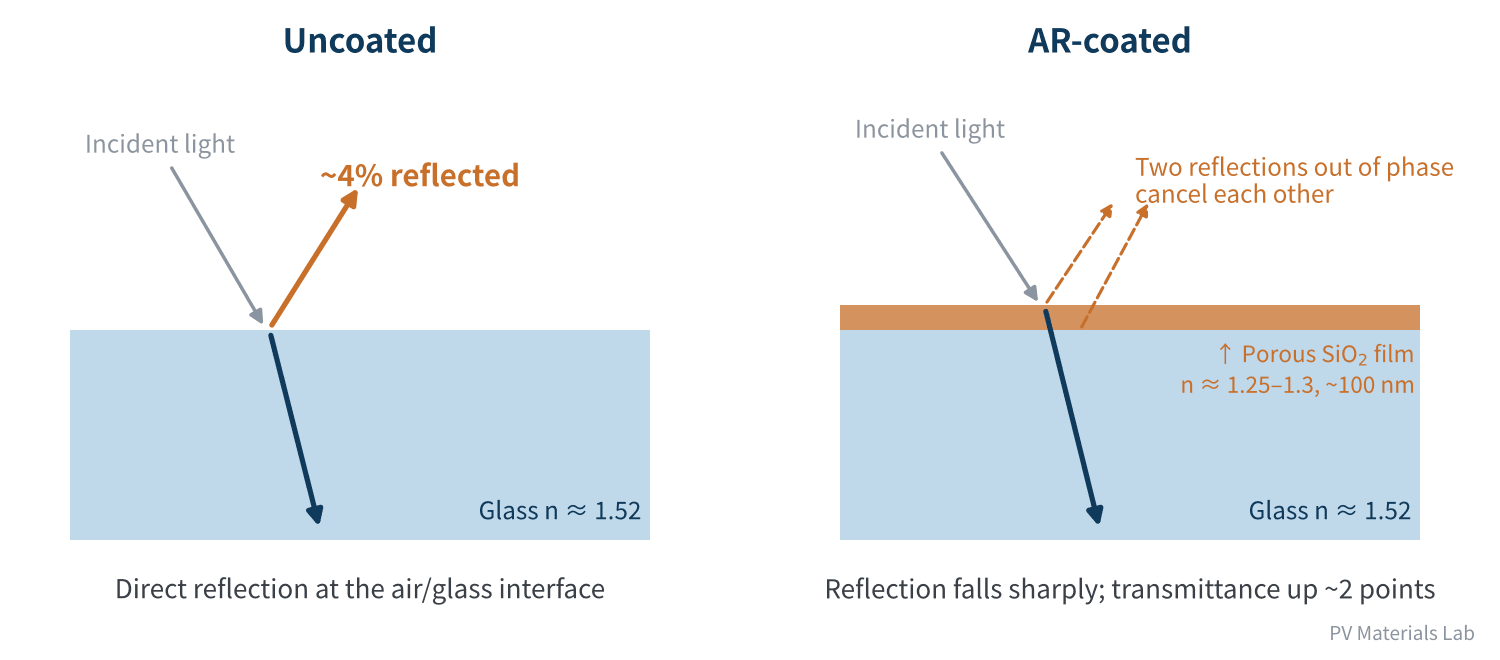
Figure 3. How an AR coating works (schematic)
A thin film with a refractive index between those of air and glass is applied to the glass surface, with a thickness of about a quarter wavelength, on the order of 100 nm. Light reflects once at the top of the film and once at the bottom; the two reflected beams are exactly out of phase and cancel, so reflection drops sharply and more light enters the glass. In theory, the ideal refractive index of a single layer is about 1.23. Dense silica cannot get that low, so the film is made porous, using the voids to "pull down" the refractive index.
Industrially, AR coatings are mainly applied by roll coating a silica sol evenly onto the air side of the glass and then cured at high temperature in the tempering furnace. The film's thickness uniformity, porosity and adhesion determine initial transmittance and long-term durability. According to an outdoor field study reported by pv magazine, AR-coated modules produced about 2% more energy over a year than uncoated modules.
The porous film's "weak spot" is equally clear: the pores adsorb moisture and contaminants, and wear resistance is lower than that of the glass itself. That is why the standard puts coated glass through washing, acid, salt mist, sand and dust and other tests. Encouragingly, recent work shows durability can be improved: in a 2024 study in a desert climate in Morocco, AR-coated samples lost only about 2.6% of their optical performance after 1,500 abrasion cycles, simulating about 29 years of weekly cleaning.
04Glazing: rear glass's little trick for extra power
The principle of grid glazing on rear glass was introduced in article 02. In production, white ceramic glaze is screen-printed onto the glass and then fired at high temperature during tempering, bonding firmly to the glass. Pattern accuracy, whiteness and adhesion of the glaze determine the front-side power gain and long-term reliability.
05Tempering: "pre-stressing" the glass
Tempering is the core step of processing. In the tempering furnace, the glass is heated to near its softening point at over 600 °C, then moved quickly into the quench section, where high-pressure air rapidly cools the top and bottom surfaces. The entire quench lasts only a few seconds to a dozen or so seconds.
During the quench, the surface cools and stiffens first while the core is still hot; when the core then cools and contracts, it "pulls" on the already-set surface, producing a stress distribution with the surface in compression and the core in tension. The distribution is roughly parabolic, with core tension about half the surface compression.
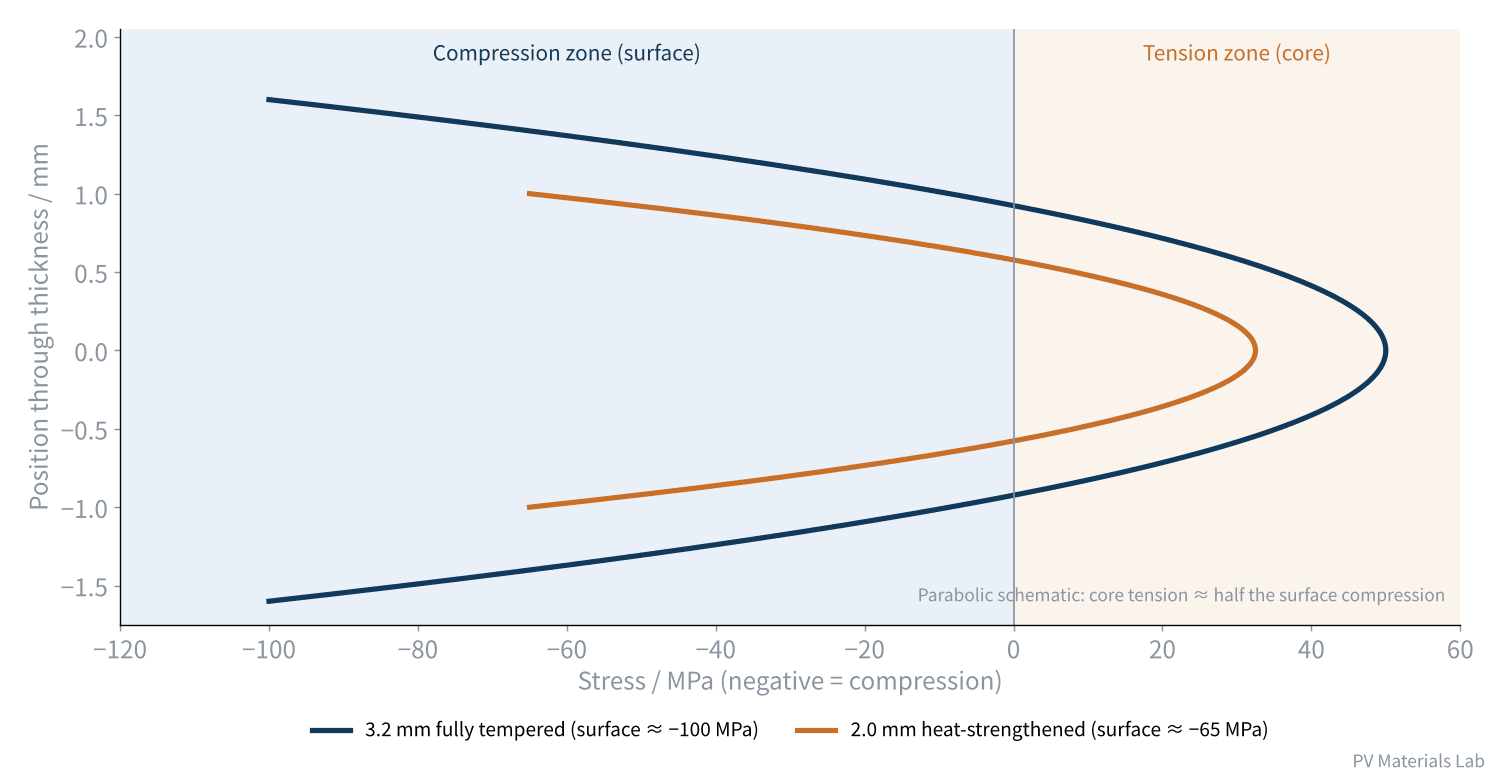
Figure 4. Stress distribution through the thickness of tempered glass (schematic)
Why does this make the glass stronger? Glass failure almost always starts from microcracks at the surface that grow under tensile stress. After tempering, the surface carries a layer of compression, and an external load must first cancel this compression before a crack can open. That is why tempered glass is several times stronger than raw glass in bending and impact. The AR coating and the glaze are also cured and fired during this very step.
06Why 2.0 mm glass can only be heat-strengthened
This is the central problem on the road to thinner glass. How much stress tempering can create depends on how large a temperature difference can be opened up between the surface and the core at the moment of quenching. The thicker the glass, the further the core is from the surface and the easier it is to build that difference; the thinner the glass, the shorter the path for heat from core to surface, the faster the temperatures even out, and the harder it is to build any difference.
- Raising air pressure: stronger cooling makes up for part of it, but the higher the pressure, the more thin glass deforms; bow, roller wave and quench marks all get worse, and energy use rises.
- Raising the exit temperature: starting the quench at a higher temperature helps build the temperature difference, but the hotter the glass, the softer it is, and the more easily it picks up roller marks and waviness on the rollers.
- Improving the heating method: air-flotation heating, for example, reduces contact between glass and rollers and improves the flatness of thin glass; it is an important direction for thin-glass tempering equipment.
So at reasonable cost and flatness, 2.0 mm glass can usually only reach surface stresses of around 60–70 MPa, which is what the industry calls "heat-strengthened". The standard requires a mean surface stress of at least 65 MPa for 2.0 mm glass, versus at least 95 MPa for 3.2 mm fully tempered glass. The 2 mm heat-strengthened solar glass launched by the US maker PPG back in 2012 was also marketed with a surface compression of over 10,000 psi (about 69 MPa), comparable to Chinese levels.
Tempering strength is fundamentally about temperature difference, and the ceiling on that difference is set by thickness. Each step thinner makes tempering harder: this is physics, not a lack of process effort.
07Common processing defects
Problems in processing often travel all the way to the module. Here are the common ones:
| Defect | Appearance | Main causes | Impact on modules |
|---|---|---|---|
| Breakage in tempering | Sheet shatters during tempering | Edge flaws, raw-sheet stress, uneven heating | Lower yield |
| Bow / roller wave | Glass not flat | Uneven heating and cooling, roller issues | Lamination bubbles, microcrack risk |
| Quench marks (anisotropy) | Patterns visible in polarised light | Uneven quenching | Appearance issue; uneven stress |
| Insufficient or uneven stress | Low surface stress, large range | Too small a temperature difference, uneven air pressure | Lower impact and load resistance |
| Uneven coating / colour variation | Inconsistent coating colour | Uneven roll-coating thickness | Transmittance variation, customer complaints |
| Spontaneous breakage | Sudden breakage without external load | Phase change of nickel sulphide and other inclusions | Mostly in fully tempered glass |
Table 1. Common processing defects and their impact
08Final thoughts
From raw sheet to PV glass, processing does three things: edging and drilling clean up the edges and hole edges where problems most often start; coating and glazing push optical performance to the limit; and tempering pre-loads the glass with a layer of compressive stress, buying several times the strength.
Running through it all, once again, are trade-offs: the more porous the coating, the higher the transmittance and the harder it is to guarantee durability; the higher the air pressure, the higher the stress and the harder it is to keep the glass flat; the thinner the glass, the lower the cost and the harder it is to temper properly.
Processing determines the final strength and transmittance of PV glass, and the conflict between "thin" and "strong" shows up most directly in tempering.
In the next article we turn these properties into indicators and tests: how are transmittance and surface stress measured, and what do the ball-drop, fragmentation and bending-strength tests each check? What hurdles must a qualified sheet of PV glass clear? Stay tuned. We would be glad to hear from you.
References
- China Photovoltaic Industry Association: T/CPIA 0028.1—2024 Glass for photovoltaic modules — Part 1: Front plate anti-reflective coated glass, 2024
- pv magazine: In search of the 'most rational design' for anti-reflective coating, 2020-08-27, https://www.pv-magazine.com/2020/08/27/in-search-of-the-most-rational-design-for-anti-reflective-coating/
- pv magazine USA: New research finds solar module anti-reflective coatings may reduce LCOE by over 2%, 2024-08-22, https://pv-magazine-usa.com/2024/08/22/new-research-finds-solar-module-anti-reflective-coatings-may-reduce-lcoe-by-over-2/
- Glassonweb: PPG makes heat-strengthened 2-millimeter glass for solar applications, 2012-11-27, https://www.glassonweb.com/news/ppg-makes-heat-strengthened-2-millimeter-glass-solar-applications
- Glaston: GlastonAir air flotation tempering technology for thin glass, 2013
- GB 15763.2—2005 Safety glazing materials in building — Part 2: Tempered glass
https://pvmaterialslab.com
A PV R&D and technical team with 10+ years of experience | In-depth technical knowledge sharing
Materials · Reliability · Failure Analysis · Standards & Certification · Products · Processes
Exploring AI + PV — collaboration welcome
Disclaimer:
1. Original content reflects the authors' personal views only, is for reference, and does not constitute investment advice.
2. Reposted and cited content is credited to its source, with respect for original work.
3. Some content is AI-assisted (chart generation, data retrieval, concept explanations, etc.); the core framework and key content are written by our technical team and reviewed by humans.
4. For any inaccuracy or infringement, please leave a message or contact us.