
Tesla's $10.1B "Silicon-to-Module" Cell Plant: Texas County Approves Tax Breaks, but the Site Isn't Final
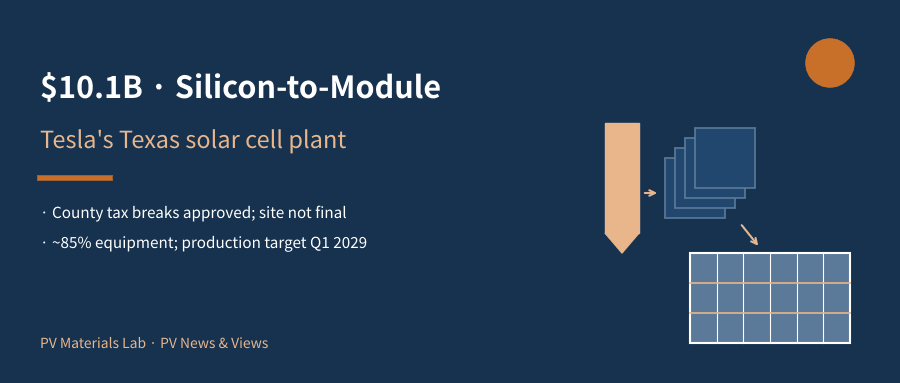
Spectrum News reports that Fort Bend County, Texas, has approved a tax abatement agreement for Tesla's solar cell manufacturing project, code-named "Project Crystal Sun." The project plans about $10.1 billion in investment and around 9,700 jobs, covering integrated "silicon-to-module" manufacturing from ingot and wafer slicing to cells, with production targeted for Q1 2029. Tesla is still comparing the site with another location outside Texas. We break down the investment structure, estimate capacity against a comparable plant, and discuss challenges in yield, equipment and labor cost.
In January, Elon Musk publicly called for 100GW a year of solar manufacturing capacity in the US. In August, Tesla filed an application in Texas for a solar cell project code-named "Project Crystal Sun." This week, Fort Bend County approved a tax abatement agreement for it. To be clear up front: construction has not started, and the site is not final.
01 What happened
Based on reporting by Spectrum News (November 5) and PV Tech (August 12), the key points are:
- Project: Code-named Project Crystal Sun, Tesla's solar cell manufacturing project, with a declared total investment of about $10.1 billion.
- Site: About 3,050 acres near Richmond in Fort Bend County, Texas. Local officials say it would be the largest single solar cell manufacturing site in the country.
- Jobs: About 9,712 permanent full-time jobs at full operation, plus about 1,147 construction jobs.
- Tax incentives: Under the agreement approved by the county, property taxes on machinery and equipment and inventory-related taxes would be waived for 10 years; the local school district approved incentives under Texas's JETI Act in September.
- Status: The governor still has to sign off. Tesla says Fort Bend is competing with another site outside Texas. If selected, construction is planned for 2026–2028, with production starting in Q1 2029.
Reports also note local opposition: some residents argue taxpayers would bear costs from day one, and worry about the lack of specific commitments on the environment, surrounding roads and water recycling.
02 What does $10.1 billion buy? 85% goes to equipment
According to the filing cited by PV Tech, about $1.5 billion of the $10.1 billion is real property, and about $8.6 billion is manufacturing equipment and other personal property, roughly 85%. This is a capital- and equipment-intensive project.
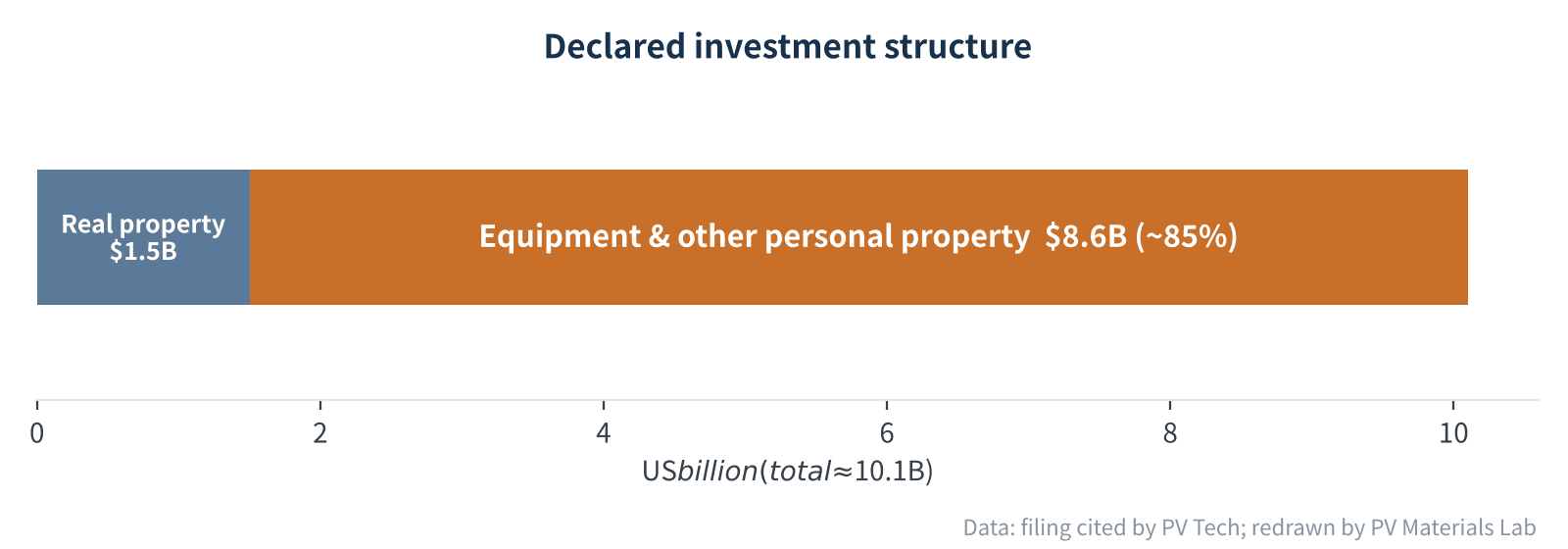
Fig. 1 Declared investment structure of Project Crystal Sun
The process scope is even more notable. The filing describes a fully integrated operation spanning the silicon-to-module value chain. The equipment list includes ingot manufacturing, wafer slicing, coating, metallization and printing, cell testing and quality control, plus material handling and cleanroom systems.
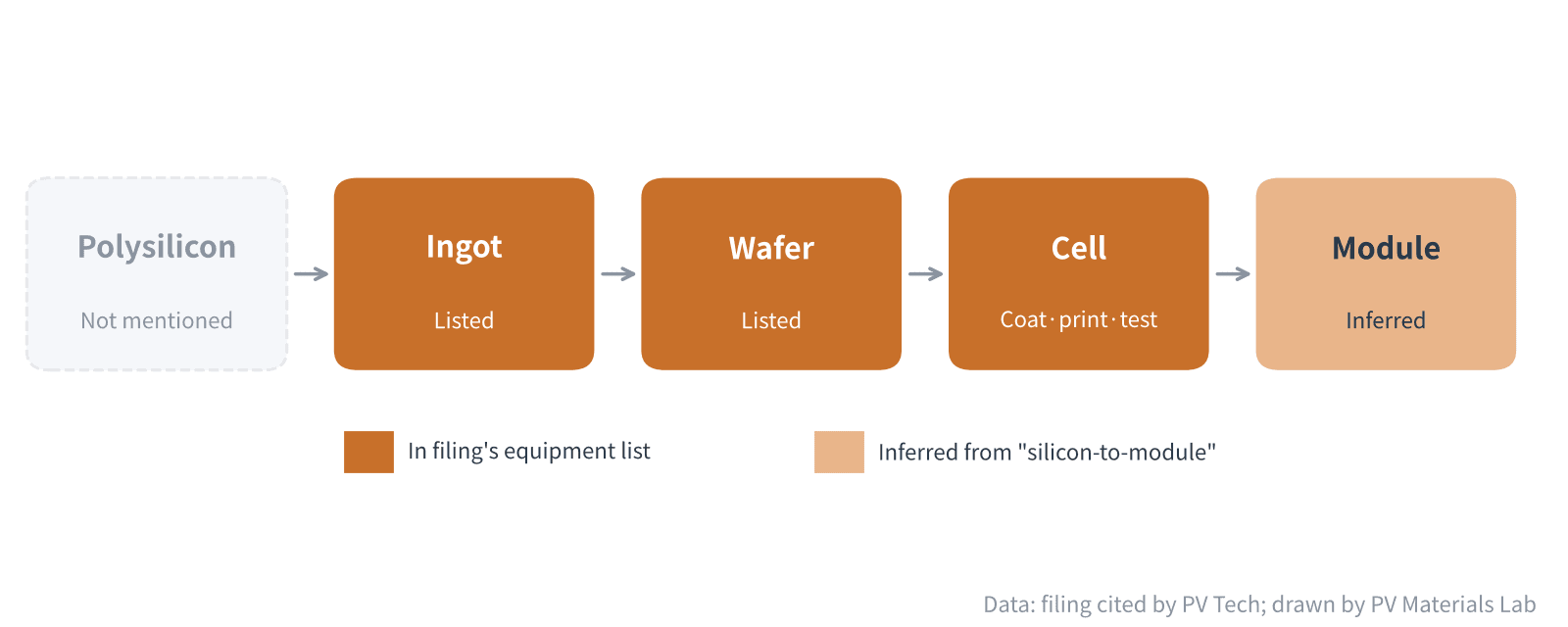
Fig. 2 Process steps referenced in the filing (schematic)
Two caveats: first, the filing does not mention polysilicon, so feedstock will most likely be purchased; second, module assembly is inferred from the "silicon-to-module" description rather than listed separately. The cell technology (TOPCon, HJT or BC) has not been disclosed.
Takeaway: This is not a simple module assembly plant but an integrated project from ingot to cell. Cells and the upstream steps are exactly what US solar manufacturing lacks most.
03 How big? Our rough estimate is 10GW or more
The filing does not disclose design capacity. A PV Tech analyst, comparing it with Qcells' Cartersville plant in Georgia, estimated a single-site capacity of more than 10GW. Cartersville cost about $2.5 billion for 3.3GW of integrated capacity.
Applying the same investment intensity, $10.1 billion corresponds to roughly 13GW. But technology, equipment configuration and construction costs may not be comparable, so this is only an order-of-magnitude reference.
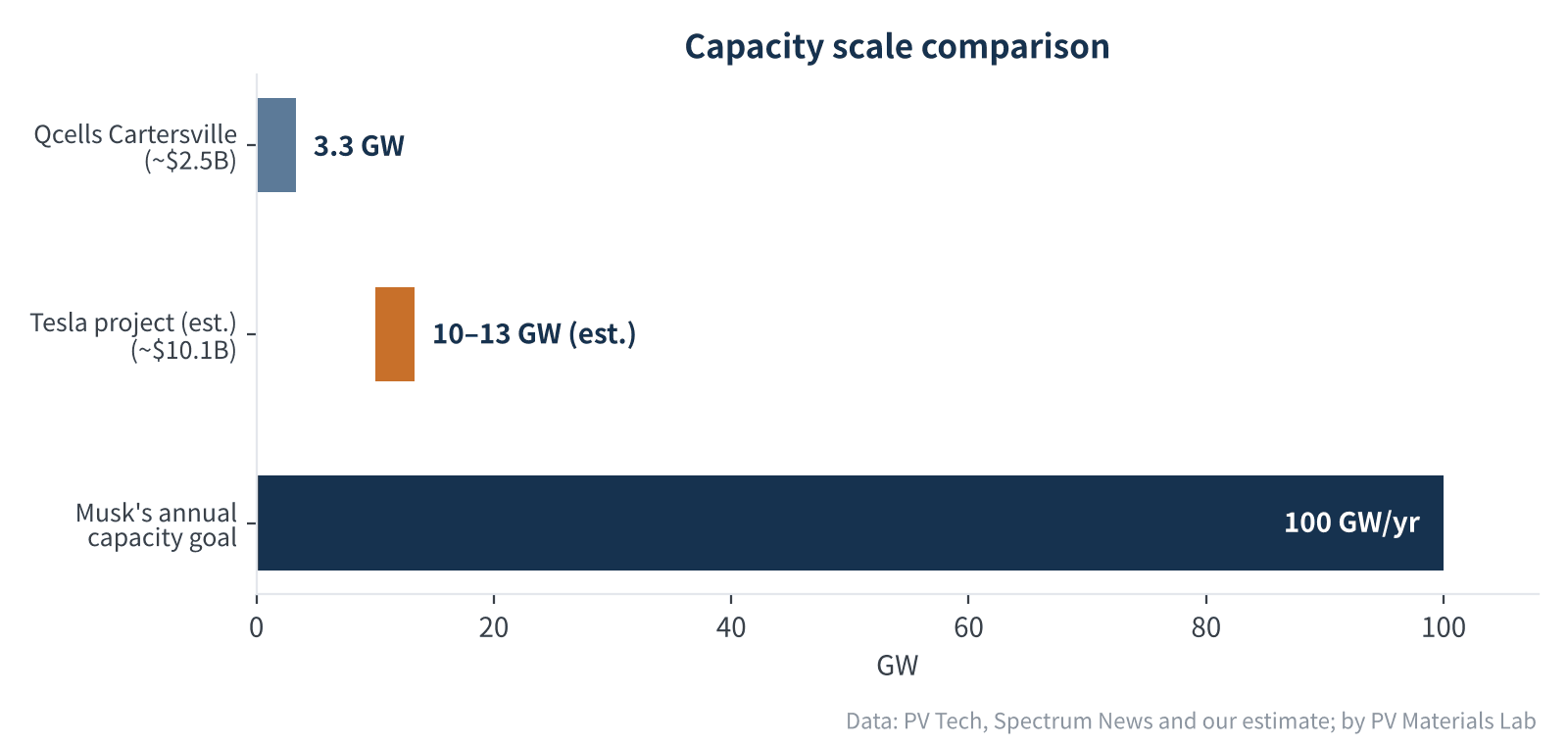
Fig. 3 Capacity scale comparison (Tesla figure is an estimate)
Against Musk's 100GW-a-year goal, even 13GW is only a small fraction. Whether 100GW is reached depends on whether more plants follow.
04 Why would Tesla make its own cells?
- The US cell gap: US module capacity has grown quickly in recent years, but cells, wafers and ingots have remained scarce and heavily import-dependent. Whoever can make cells domestically controls a key link in the supply chain.
- Policy direction: US domestic manufacturing tax credits and restrictions on foreign-affiliated entities are pushing companies to bring upstream capacity home. Property tax relief under Texas's JETI Act adds another layer of local incentive.
- Own demand and narrative: Tesla has storage and solar businesses, and Musk has set large-scale solar goals. In-house cell capacity reduces reliance on outside suppliers and fits Tesla's long-standing vertical integration approach.
05 Where are the hard parts?
From our experience in material qualification and process development, the hard part of an integrated cell plant is not the building, but the following:
- Yield ramp: Ingot, wafer and cell each have their own yield curve, and integration means losses compound across stages. Moving from first production to stable volume usually takes a long ramp.
- Equipment and materials supply chain: Mainstream crystal pullers, wire saws, cell tools and key consumables are highly concentrated in China. Under trade restrictions, procurement, commissioning and spare parts are real issues.
- Labor cost: Reports say the jobs pay at least $55 an hour. Our rough math puts annual labor cost for 9,712 people at about $1.1 billion, or about $0.11/W spread over 10GW. That is not low for an industry that competes on cost per kilowatt-hour.
- Technology turnover: Production starts only in 2029, and cell technology moves fast. Whether the chosen route will still be competitive at start-up is an unavoidable question for capital-heavy projects.
Bottom line: Money and land are the easy parts; yield, equipment and people are the hard ones. Whether an integrated cell plant can be competitive won't be clear until after 2029.
06 Our view
Value: this is an important signal of US solar manufacturing extending into cells and upstream. The investment scale, process scope and job commitments are substantial and matter for the completeness of the US supply chain.
Limitations: the site is not final, the governor has not signed, design capacity and technology are undisclosed, and a 2029 start means a long period of uncertainty. The tax incentives also face local opposition. Treating it as a "done deal" factory would be inaccurate at this stage.
China context: Chinese integrated manufacturers have already traveled this road and built deep experience in scaling and controlling yield across ingot, wafer and cell. Localization projects overseas may create export opportunities for equipment, consumables and technical services, while also gradually reducing the US market's reliance on imported products. Both deserve continued attention from Chinese peers.
07 Final thoughts
Tesla building a cell plant is easy to frame as "Musk disrupts solar again." For practitioners, the equipment list and the yield curve are what really matter.
We will keep following where the site lands, when the governor signs, and when capacity and technology are announced.
Calculation notes / data basis
- Equipment share: $8.6B ÷ $10.1B ≈ 85%, from the filing cited by PV Tech.
- Capacity estimate: using Qcells Cartersville's intensity of about $2.5B for 3.3GW, $10.1B × 3.3 / 2.5 ≈ 13GW; technologies and equipment differ, so this is an order-of-magnitude reference only. A PV Tech analyst estimated "more than 10GW."
- Labor cost: 9,712 people × $55/hour × 2,080 hours/year ≈ $1.11B/year; about $0.11/W over 10GW. The wage figure is from Spectrum News; benefits are excluded; rough estimate only.
- "Scarce US cell and upstream capacity" is a general industry view; no specific capacity figures are cited.
References
- Spectrum News. Tesla considers Fort Bend for $10 billion solar manufacturing site, 2026-11-05. https://spectrumlocalnews.com/tx/austin/news/2026/11/05/tesla-considers-fort-bend-for--10-billion-solar-manufacturing-site
- PV Tech. Tesla plans US$10.1 billion vertically integrated solar cell plant in Texas, 2026-08-12. https://www.pv-tech.org/tesla-plans-us10-1-billion-vertically-integrated-solar-cell-plant-in-texas/
- Electrek. Tesla solar cell factory Texas: Project Crystal Sun, 2026-08-11. https://electrek.co/2026/08/11/tesla-solar-cell-factory-texas-project-crystal-sun/
- Manufacturing Dive. Tesla eyes $10B solar cell manufacturing site in Fort Bend County, Texas. https://www.manufacturingdive.com/news/tesla-eyes-10b-solar-cell-manufacturing-site-fort-bend-county-texas/828372/
PV Materials Lab
https://pvmaterialslab.com
PV Materials Lab
A PV R&D and technical team with 10+ years of experience | In-depth technical knowledge sharing
Materials · Reliability · Failure Analysis · Standards & Certification · Products · Processes
Exploring AI + PV — collaboration welcome
Disclaimer:
- Original content reflects the authors' personal views only, is for reference, and does not constitute investment advice.
- Reposted and cited content is credited to its source, with respect for original work.
- Some content is AI-assisted (chart generation, data retrieval, concept explanations, etc.); the core framework and key content are written by our technical team and reviewed by humans.
- For any inaccuracy or infringement, please leave a message or contact us.