
Chosen by Building Safety: Applications and Limitations of PVB Interlayers in PV Modules
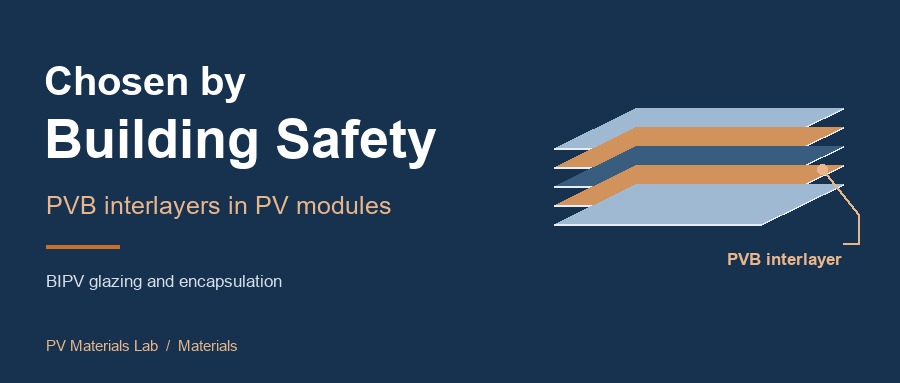
Key Takeaways
Niche Division: Utility-scale and standard rooftop modules rely almost exclusively on EVA, POE, or co-extruded EPE. Once a project enters BIPV applications—such as curtain walls, skylights, and canopies—PVB (polyvinyl butyral) becomes a frequent specification, driven primarily by architectural safety glass codes rather than energy yield.
Fundamental Chemistry: EVA and POE are thermosetting encapsulants that form irreversible 3D crosslinked networks during lamination. PVB is a thermoplastic interlayer that relies on strong hydrogen bonding between its hydroxyl groups and glass surfaces rather than chemical crosslinking.
Double-Edged Hydroxyls: Those hydroxyl groups deliver outstanding glass adhesion, impact safety, and UV stability—but also create PVB's four major engineering vulnerabilities: high moisture uptake, weak water vapor barrier (high WVTR), moisture-sensitive insulation resistance, and elevated-temperature creep.
Production & Qualification Guardrails: Never substitute standard architectural PVB for PV-grade high-resistivity PVB. Manufacturing lines must strictly control film moisture content (typically 0.4%–0.5%) and layup room humidity, while verifying edge sealing and silicone sealant compatibility upfront.
Spend enough time inside a mainstream PV module factory and it is easy to assume encapsulation boils down to three choices: EVA, POE, and EPE.
Yet the moment an R&D or procurement team steps into a Building-Integrated Photovoltaics (BIPV) tender—a high-rise solar curtain wall, a transit hub skylight, or an overhead walkway canopy—a surprising requirement frequently appears in the specification. Architectural design institutes and facade consultants explicitly mandate PVB (or higher-modulus ionoplast interlayers such as SGP), often ruling out conventional EVA or POE outright.
Both are glass-glass PV modules. Why does the utility-scale market avoid PVB while architectural PV relies on it? The answer lies in a collision between two engineering philosophies: utility PV optimizes 25-to-30-year LCOE and electrical degradation margins, whereas building engineering puts structural integrity and overhead fall safety first.
In this article, we break down PVB's molecular origins, engineering trade-offs, first-principles mass math, and factory-floor pitfalls.
01|What Is PVB, and Why Is It Fundamentally Different from EVA/POE?
PVB stands for polyvinyl butyral, synthesized by reacting polyvinyl alcohol (PVA) with butyraldehyde under acidic conditions and extruded into sheets with plasticizers (commonly triethylene glycol di-2-ethylhexanoate, or 3GO).
Most readers encounter PVB every day: it is the transparent interlayer laminated inside automotive windshields and architectural safety glass, backed by more than half a century of outdoor field history.
Chemically, a PVB chain carries three functional groups: butyral rings (providing toughness and non-polar compatibility), residual hydroxyl groups (typically 18%–23%, strongly polar), and minor acetate groups.
This architecture creates the sharpest dividing line between PVB and conventional PV encapsulants:
● EVA / POE (Thermosetting Crosslinked Systems): Peroxide curing agents trigger chemical crosslinking at 140–155 °C during lamination, building an irreversible 3D polymer network that locks in thermal stability and creep resistance.
● PVB (Thermoplastic System): No chemical crosslinking occurs. Under heat and pressure, PVB softens, wets the glass, expels air, and bonds tightly to glass surfaces via dense hydrogen bonds between its hydroxyl groups and silanol groups on the glass.
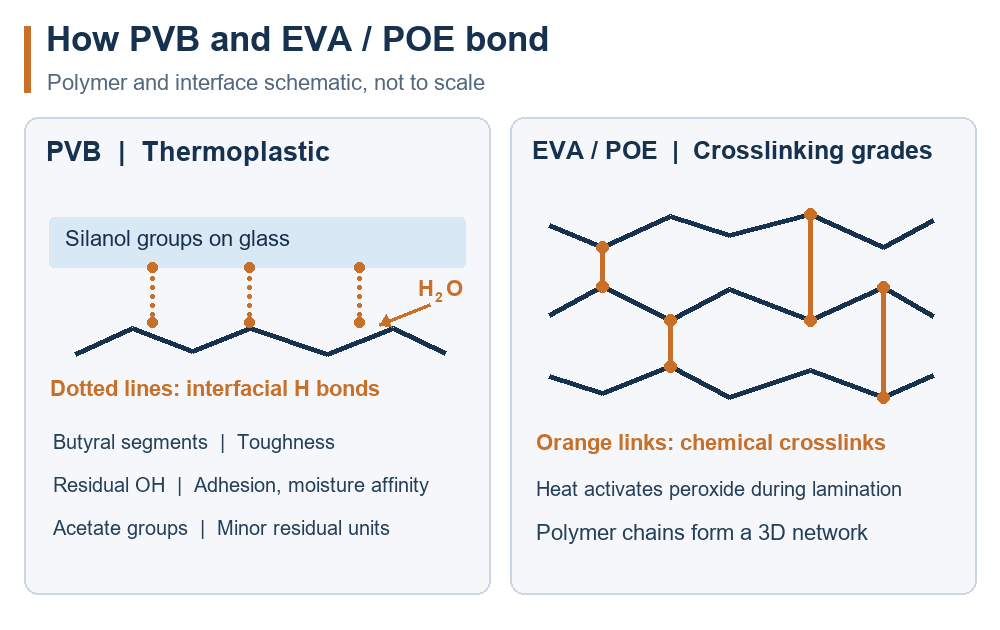 Figure 1 | PVB hydrogen bonding and the crosslinked EVA/POE network. Source: PV Materials Lab.
One critical distinction must be drawn early: PV-grade PVB is not off-the-shelf architectural PVB. Standard architectural grades optimize optical clarity, impact retention, and acoustics, with little regard for electrical insulation—resulting in relatively low volume resistivity. PV-grade modified PVB (governed in China by JG/T 449-2014) adjusts resin purity, plasticizer chemistry, and additive packages to elevate volume resistivity, tune UV cut-off/transmittance, and improve melt flow around interconnects.
02|Why BIPV Relies on PVB: Four Core Strengths
When a PV module sits 50 meters up on a building facade or directly above pedestrian traffic, it is legally a safety glazing element first and a power generator second. Four intrinsic strengths align PVB with architectural mandates:
1. Architectural-Grade Impact Resistance and Post-Breakage Retention PVB offers high tensile toughness and penetration resistance. Even if tempered glass shatters due to hail, wind load, or spontaneous nickel sulfide breakage, strong hydrogen bonding holds glass shards securely to the interlayer—preventing hazardous overhead glass fallout and meeting safety glass standards such as GB 15763.3, GB/T 29551-2023, and international equivalents (EN 14449, ANSI Z97.1). Standard EVA/POE formulations are tuned for electrical encapsulation and PID resistance rather than architectural tear retention.
2. Proven UV Stability and Yellowing Resistance Unlike conventional EVA, which can undergo deacetylation and acetic-acid-assisted yellowing under prolonged UV and damp-heat exposure, PVB lacks hydrolyzable vinyl acetate side chains. Its multi-decade track record in windshields and glass facades makes it easier to guarantee long-term visual uniformity across building elevations.
3. Architectural Functional Versatility The architectural glazing supply chain already offers colored, frosted, ceramic-frit-compatible, and acoustic multi-layer PVB interlayers. For BIPV facades balancing solar heat gain coefficient (SHGC), exterior aesthetics, and urban sound attenuation, PVB integrates smoothly into existing architectural toolkits.
4. End-of-Life Recyclability Potential Without a permanent crosslinked network, thermoplastic PVB is inherently more amenable to mechanical or solvent-assisted glass separation—an emerging advantage in European and other markets tightening embodied-carbon and building-material circularity rules.
03|Why Utility-Scale Plants Avoid PVB: Four Engineering Limitations
If PVB excels in safety and UV durability, why is it virtually absent from utility-scale and standard C&I installations? The exact chemical features that make PVB great for glazing introduce four tough constraints for mainstream PV.
Limitation 1: Inherent Hydrophilicity and Weak Moisture Barrier
The same hydroxyl groups that bond PVB so tenaciously to glass are strongly hydrophilic. As a result, PVB readily absorbs ambient moisture and exhibits a water vapor transmission rate (WVTR) roughly an order of magnitude higher than POE—and noticeably higher than conventional EVA at comparable thicknesses.
In unsealed frameless glass-glass modules, moisture wicks inward from exposed edges, triggering edge whitening, delamination, and accelerated metallization corrosion.
Limitation 2: Moisture-Sensitive Insulation and PID Risk
Modern utility plants operate at 1500 V DC system voltage, demanding ultra-high electrical insulation. POE routinely achieves volume resistivities of 1015–1016 Ω·cm. By contrast, standard architectural PVB sits around 1010–1012 Ω·cm and drops steeply as temperature and absorbed moisture rise.
Even PV-grade high-resistivity PVB (typically reaching 1013–1014 Ω·cm under dry ambient conditions) leaves less safety margin against leakage currents and Potential-Induced Degradation (PID) under damp-heat bias (85 °C / 85% RH) than high-resistivity POE.
Limitation 3: Thermoplastic Creep at Elevated Temperatures
Because PVB does not crosslink, its shear modulus drops substantially at elevated temperatures. Under summer irradiance—especially in poorly ventilated BIPV spandrels or roof cavities—module operating temperatures easily exceed 65–75 °C.
Combined with gravity-induced shear stress on inclined or vertical installations, soft PVB grades face risks of glass-to-glass slippage, edge bleed-out, or bubble reappearance near solder ribbons. For steep skylights or point-fixed canopies with high thermal loads, facade engineers often step up from PVB to stiffer ionoplast interlayers (SGP).
Limitation 4: Thickness, Mass, and LCOE Economics
First-principles mass math quickly exposes why utility projects pass on PVB:
● Conventional c-Si glass-glass module: Dual layers of EVA/POE typically total 840–920g/m2 (~0.45–0.50mm per ply).
● c-Si BIPV glass-glass module: Accommodating solder ribbon steps while meeting architectural glazing thickness rules frequently requires two plies of 0.76mm PVB (1.52mm total). At a typical PVB density of 1.07g/cm3, encapsulant areal mass reaches 1,626g/m2 (~1.63kg/m2).
In encapsulant mass alone, a c-Si PVB stack uses 1.77x to 1.94x the material of a conventional stack. On a 2.5m2 module, the film alone adds roughly 1.88 kg (before accounting for the thicker 5 mm + 5 mm architectural tempered glass typical in BIPV). Combined with higher resin pricing and longer lamination cycle times, PVB simply cannot compete on utility LCOE.
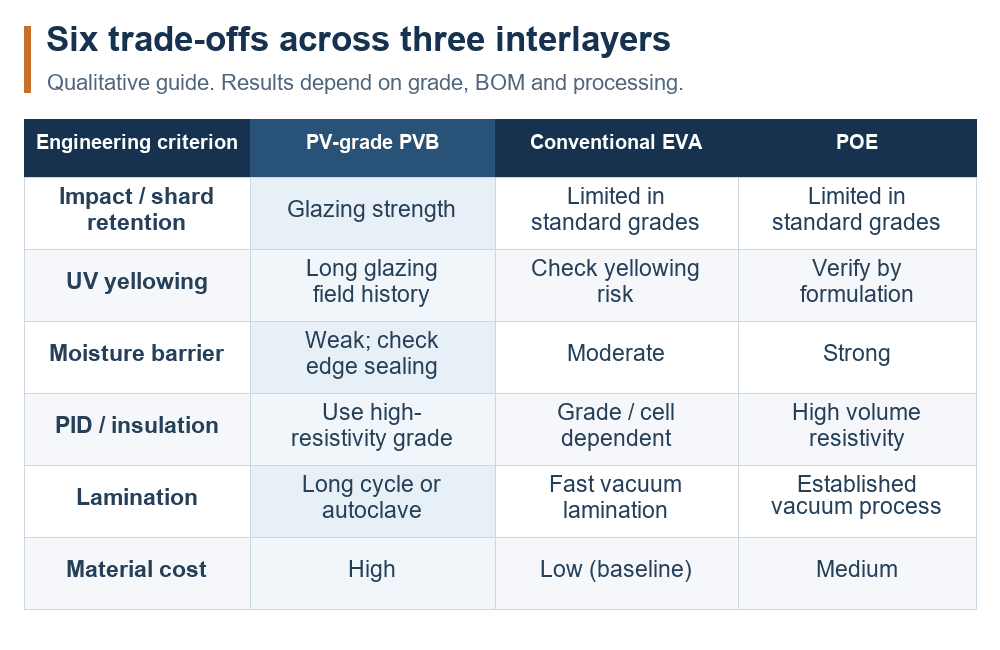 Figure 2 | Six engineering trade-offs for PV-grade PVB, EVA and POE (qualitative). Source: PV Materials Lab.
04|Head-to-Head Comparison: PVB vs. EVA vs. POE/EPE vs. SGP
Table 1 summarizes the trade-offs across the four primary encapsulant families used in conventional PV and BIPV projects.
Table 1|Key Engineering Parameters Across Four PV & BIPV Encapsulant Families
| Parameter | PV-Grade PVB | Conventional EVA | POE / Co-Extruded EPE | Ionoplast (e.g., SGP) |
|---|---|---|---|---|
| Bonding Mechanism | Thermoplastic (non-crosslinked, hydrogen bonding) | Thermosetting (peroxide crosslinked) | Thermosetting (peroxide crosslinked) | Thermoplastic ionomer (ionic-cluster physical crosslinks) |
| Typical Thickness / Grammage | Thin-film: 0.76mm; c-Si: 0.76mm×2 (~1.63kg/m2) | Dual-layer total ~840–920g/m2 | Dual-layer total ~840–920g/m2 | Common 0.89mm or 1.52mm stacks |
| Moisture Barrier (WVTR) | Weak (hygroscopic, vulnerable at unsealed edges) | Moderate (hydrolyzes into acetic acid under DH) | Excellent (industry-leading moisture barrier) | Good (markedly superior edge stability vs. PVB) |
| PID & Insulation | Moderate-to-low (requires PV-grade high-resistivity formula) | Moderate (depends on formulation & cell tuning) | Excellent (high volume resistivity; N-type standard) | Good (verify specific PV-qualified grade) |
| Building Safety & Impact | Excellent (proven architectural safety glazing) | Limited (rarely meets strict overhead codes alone) | Limited (not engineered for facade safety codes) | Best-in-class (high tear strength & post-breakage stiffness) |
| High-Temp Creep Resistance | Fair (modulus drops significantly at elevated temp) | Good (crosslinked dimensional stability) | Good (crosslinked dimensional stability) | Excellent (retains high stiffness at elevated temp) |
| Lamination Process | Vacuum laminator (long cycle) or nip-roll + autoclave | Vacuum laminator (fast throughput) | Vacuum laminator (mature high-volume process) | Autoclave or dedicated high-temp vacuum lamination |
| Material Cost | High | Low (baseline) | Moderate | Very High |
| Primary Applications | Solar curtain walls, canopies, skylights, thin-film BIPV | Utility-scale plants, standard rooftop modules | N-type glass-glass plants, humid/coastal sites | Large-span skylights, point-fixed facades, typhoon-zone BIPV |
The takeaway is straightforward: encapsulant selection is never about which polymer is "better" in isolation, but which failure boundary governs the installation. When overhead safety is mandatory and PVB's post-breakage stiffness or creep margin falls short, engineers escalate to SGP. Where building fall-safety codes do not govern, POE/EPE and EVA remain unbeatable.
05|Factory & Qualification Pitfalls: Five Critical Control Points
For teams moving PVB modules from design review into production, certification, and facade installation, five control points separate reliable field performance from costly failures.
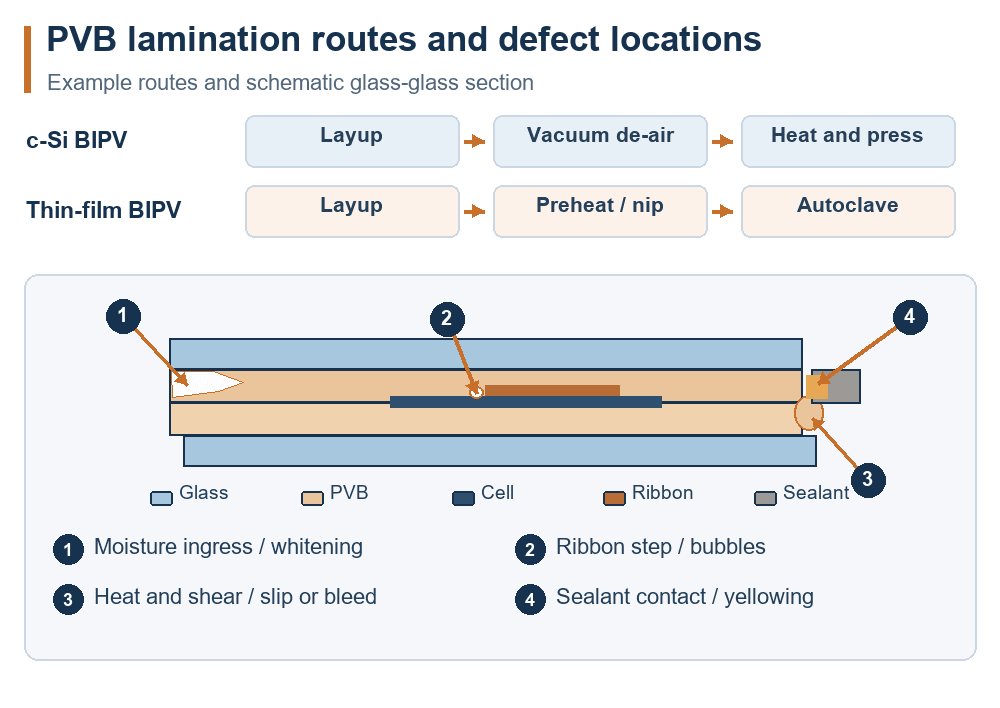 Figure 3 | PVB lamination routes and typical defect locations in glass-glass modules. Source: PV Materials Lab.
Pitfall 1: Uncontrolled Layup Humidity and Film Moisture Content
PVB acts like a moisture sponge. Film moisture content must be tightly held within 0.4%–0.5%:
● Too wet (>0.6%): Trapped moisture vaporizes during lamination, generating micro-bubbles and accelerating damp-heat edge delamination.
● Too dry (<0.3%): Glass-to-PVB adhesion climbs too high, reducing the film's ability to deform locally upon impact and paradoxically lowering impact test performance.
Rolls require chilled storage (typically below 10 °C) to prevent blocking, and the layup cleanroom must be strictly climate-controlled (commonly 18–22 °C, 20%–30% RH) with capped open-roll exposure times.
Pitfall 2: Applying the Same Process Route to c-Si and Thin-Film Modules
Thin-film BIPV (CdTe, a-Si, CIGS) and crystalline silicon (c-Si) BIPV behave completely differently during lamination:
● Thin-film BIPV: Cells are deposited directly onto flat glass substrates without raised solder ribbons or fragile wafers. They pair naturally with established architectural pre-nip + autoclave lines (~1.0–1.3 MPa), achieving high cosmetic yield with a single 0.76mm PVB layer.
● c-Si BIPV: Brittle wafers and ribbon/busbar step heights make high-pressure autoclaves a microcrack hazard unless cushioning and pressure ramps are tightly engineered. Most c-Si PVB lines favor single-step vacuum laminators (~0.1 MPa membrane pressing), requiring extended evacuation, gentle heating ramps, longer dwell times, and adequate film thickness to overcome PVB's high melt viscosity and eliminate linear air pockets along ribbons.
Pitfall 3: Skipping Edge Sealing and Structural Sealant Compatibility Testing
Unlike conventional frameless double-glass modules, PVB laminates should rarely be left with permanently wet, unsealed edges. Incorporating polyisobutylene (PIB) butyl edge seals or well-drained glazing gaskets is essential to block liquid water ingress.
Equally treacherous is chemical incompatibility. Curtain wall installations rely on neutral-cure silicone weatherproofing and structural sealants. Low-molecular-weight components in unverified sealants can interact with PVB plasticizers, triggering edge yellowing or adhesive softening. Always run formal compatibility tests on the exact project BOM (specific PVB grade + specific silicone sealant) before freezing specifications.
Pitfall 4: Substituting Architectural PVB for PV-Grade PVB
Some traditional glass processors entering BIPV substitute stocked architectural PVB to trim BOM cost. Modules pass visual outgoing QC effortlessly—only to fail insulation resistance, exhibit rapid power drop, or suffer edge whitening during DH1000 (85 °C / 85% RH, 1,000 h) or PID qualification. Lock the exact PV-grade SKU in the procurement contract and verify transmittance, volume resistivity, and damp-heat retention against JG/T 449-2014 or equivalent project specs.
Pitfall 5: Passing PV Certification While Failing Building Approval
BIPV is a dual-compliance product. Passing IEC 61215 and IEC 61730 alone does not satisfy architectural facade codes; conversely, holding safety glass certification alone says nothing about 25-year electrical reliability. Align IEC 63092-1:2020, GB/T 29551-2023, and GB 15763.3 (or local building codes) from Day 1 so structural load, fire rating, impact glazing, and electrical safety are engineered in parallel.
Quick-Reference Selection Guide
Table 2|Encapsulant Selection Quick-Reference by PV Application
| Application Scenario | Preferred Encapsulant | PVB Suitability | Critical Verification Items |
|---|---|---|---|
| Utility-Scale / Standard C&I Rooftop | POE / EPE / EVA | Not recommended (cost, WVTR, PID disadvantages) | PID resistance, DH1000 degradation, grammage vs. LCOE |
| BIPV Curtain Walls (Vertical Facades) | PV-Grade PVB / certified specialty glazing stacks | Highly suitable (mature architectural ecosystem) | Safety impact rating, silicone compatibility, edge drainage/sealing |
| Solar Skylights / Canopies / Overhead Glazing | PV-Grade PVB or SGP | Highly suitable (consider SGP for large spans/high load) | Post-breakage residual load, high-temp creep, hail impact |
| Thin-Film BIPV (e.g., CdTe Solar Glass) | PV-Grade PVB | Excellent match (flat substrate fits autoclave process) | PIB edge-seal integrity, moisture barrier, busbar insulation |
| Lightweight Flexible Rooftop PV | POE / specialized fluoropolymer stacks | Not applicable (requires rigid glass-glass structure) | Weight limit, flexural fatigue, backsheet WVTR |
One-Sentence Conclusion
PVB was never engineered to beat EVA or POE on utility LCOE—it was chosen to bring solar modules safely into buildings; unlocking its value requires pairing its architectural impact and UV strengths with PV-grade formulations, humidity-controlled lamination, and disciplined edge sealing.
Methodology & Data Notes
- Encapsulant Grammage & Mass Delta Calculation:
○ Conventional c-Si glass-glass baseline: Dual-layer EVA/POE/EPE total grammage assumed at 840–920g/m2 (midpoint 880g/m2, or 0.88kg/m2, used for module weight delta).
c-Si BIPV dual-layer PVB stack: Two plies of 0.76mm (1.52mm total) at typical PVB density ρ=1.07g/cm3 (typical industry range 1.06–1.08g/cm3):
1.52mm×1.07g/cm3=1,626.4g/m2≈1.63kg/m2
○ Mass ratio: 1,626.4/920≈1.77×; 1,626.4/840≈1.94×. For a 2.5m2 module, encapsulant-only mass increase is (1.63-0.88)×2.5=1.875kg≈1.88kg. For thin-film BIPV using a single 0.76mm PVB ply, areal mass is ~813g/m2, comparable to conventional dual-layer stacks.
- Material Property Ranges:
○ Quoted volume resistivity, WVTR relative rankings, moisture content targets, and cleanroom parameters represent typical industry engineering windows. Actual values vary by resin grade, plasticizer loading, specimen thickness, and test environment; project designs should rely on supplier TDS and accredited third-party test reports (e.g., TÜV, CGC, accredited glazing labs).
- Standard Editions:
○ Standards reflect widely referenced editions. For standards undergoing revision cycles (such as the GB 15763.3 series), confirm the active edition enforced by local building authorities at the time of tender and certification.
References
GB/T 29551-2023, Solar Photovoltaic Laminated Glass for Building (superseding GB/T 29551-2013)
GB 15763.3-2009, Safety Glazing Materials in Building — Part 3: Laminated Glass (and subsequent active revisions)
JG/T 449-2014, Polyvinyl Butyral (PVB) Film for Building Photovoltaic Modules
IEC 63092-1:2020, Photovoltaics in buildings — Part 1: Requirements for building-integrated photovoltaic modules
IEC 61215:2021, Terrestrial photovoltaic (PV) modules — Design qualification and type approval
IEC 61730:2023, Photovoltaic (PV) module safety qualification
PV Materials Lab
https://pvmaterialslab.com
PV Materials Lab
A team with over a decade of PV R&D and technical experience | In-depth technical knowledge sharing
Materials · Reliability · Failure analysis · Standards and certification · Products · Processes
AI+PV exploration and exchange; collaboration welcome
Disclaimer:
1. Original content expresses the author's views only, is for reference only, and does not constitute investment advice.
2. Reproduced and cited content is attributed to its sources, with respect for original work.
3. Some content includes AI assistance (chart generation, data retrieval, conceptual explanations, etc.); the core framework and key content are written by this technical team and reviewed by humans.
4. If you find any inaccuracy or infringement, please leave a comment or contact us so we can address it.