
Silicone on PV Modules: Where It Goes, What It Does, and Why Silicone
Silicone Basics Series · 01
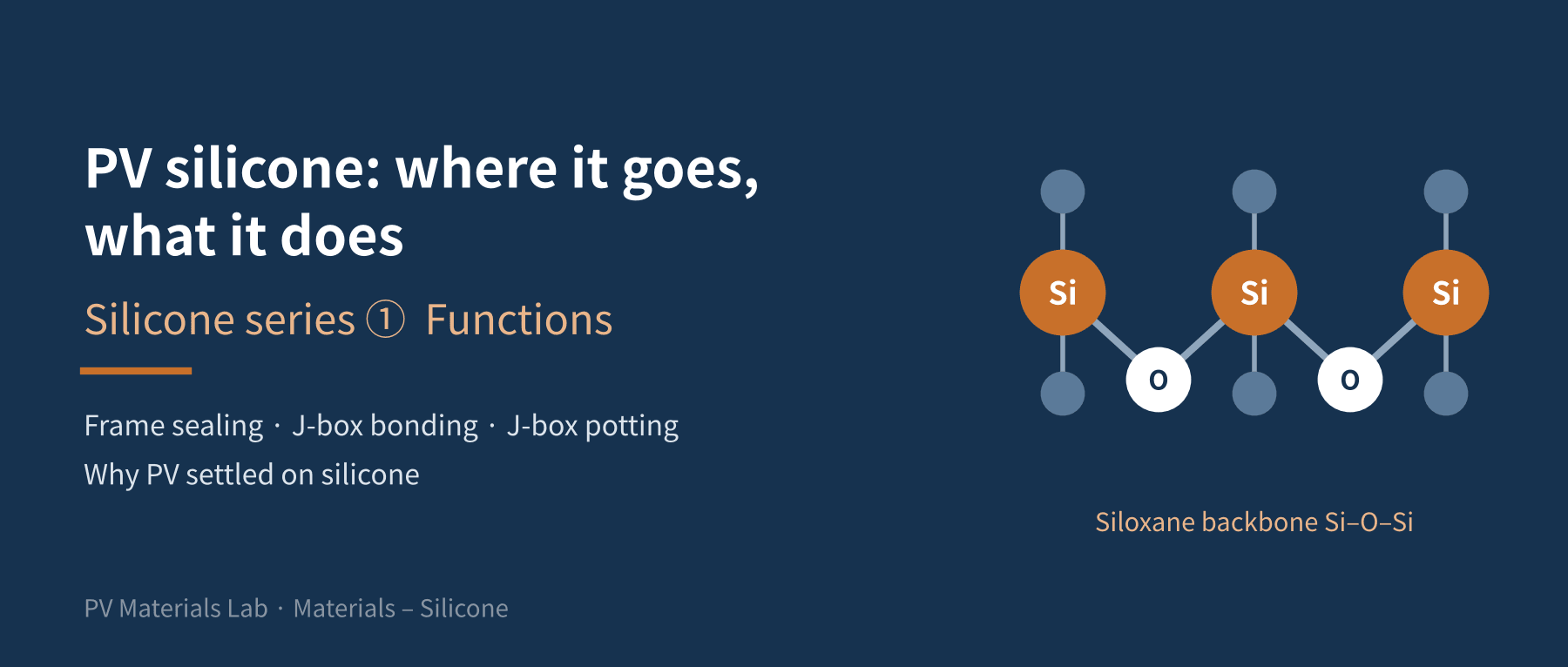
Silicone is a small, non-generating part of a PV module, yet it guards three places at once: the frame channel, the underside of the junction box and the junction box cavity. This first article in our silicone series explains what PV silicone is, what the frame sealant, the junction box adhesive and the potting compound each have to do, why the industry settled on silicone, and where its weaknesses lie.
Silicone generates no power and lets no light through, and it is a small share of a module's weight and cost. Yet it guards three places at once: the gap between frame and laminate, the bond between the junction box and the rear of the module, and the live parts inside the junction box. This is the first article in our silicone series. We start with the basics: where the silicone goes, what each bead has to do, and why it is silicone and not something else.
01 First, which “silicone” are we talking about?
What the industry casually calls “silicone” is more precisely a silicone sealant, or room temperature vulcanizing (RTV) silicone rubber: a paste or liquid that cures into an elastic rubber at ambient temperature. It is not the granular silica gel found in desiccant sachets. The Chinese national standard GB/T 29595 calls it “silicone sealant” for terrestrial PV modules.
Its backbone is a chain of alternating silicon and oxygen atoms (Si–O–Si), with organic groups such as methyl attached on the sides. The backbone resembles an inorganic material and the side groups an organic one, so silicone combines the weather resistance of the former with the flexibility of the latter. All of its properties come from this structure, as section 06 explains.
02 Where silicone is used on a module
On a conventional framed module, silicone appears in three places (Figure 1). The first two normally use a one-part product, the third a two-part product.
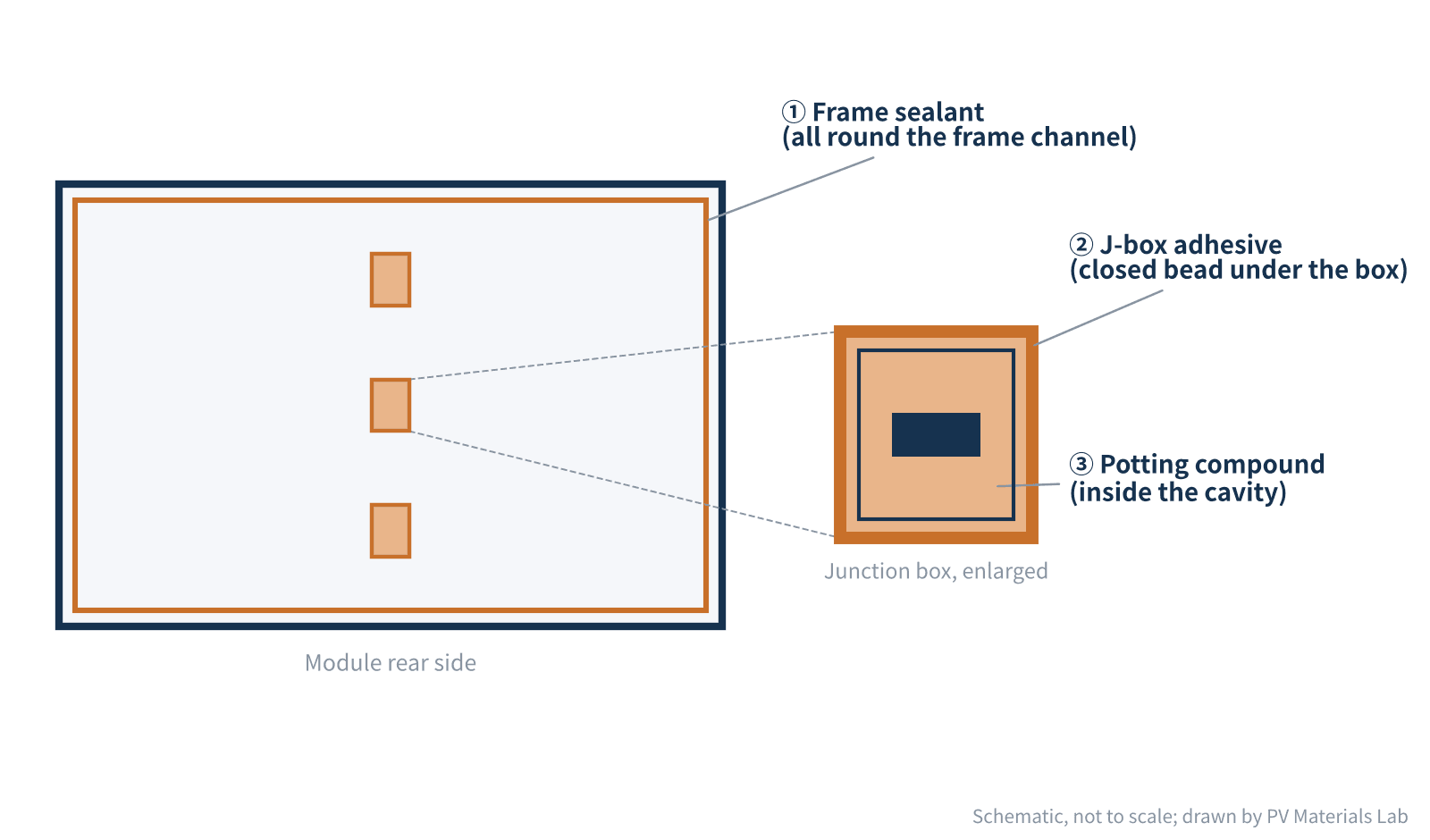
Figure 1 The three silicone locations on a module (schematic, rear view)
| Location | Typical product | Form | Main job |
|---|---|---|---|
| Frame channel | One-part sealant | Paste, dispensed into the channel | Sealing, bonding, cushioning |
| Underside of junction box | One-part adhesive | Paste, applied as a closed bead | Fixing the box, sealing its base |
| Junction box cavity | Two-part potting compound | Liquid, mixed and poured in | Insulation, moisture protection, heat conduction, flame retardancy |
There are also less standard locations: rear hooks or rails on frameless glass-glass modules and building-integrated (BIPV) elements use structural silicone that carries load over the long term. We will come back to these when the series reaches future trends.
03 Frame sealant: three jobs in one gap
The four edges of the laminate (glass, encapsulant, cells and backsheet or rear glass pressed into one piece) are the weakest part of the package: the cut edge of the encapsulant is exposed, and so are the end faces of the backsheet layers. The channel of the aluminium frame wraps around these edges, and silicone fills the space between channel and laminate (Figure 2). That bead does three things at once.
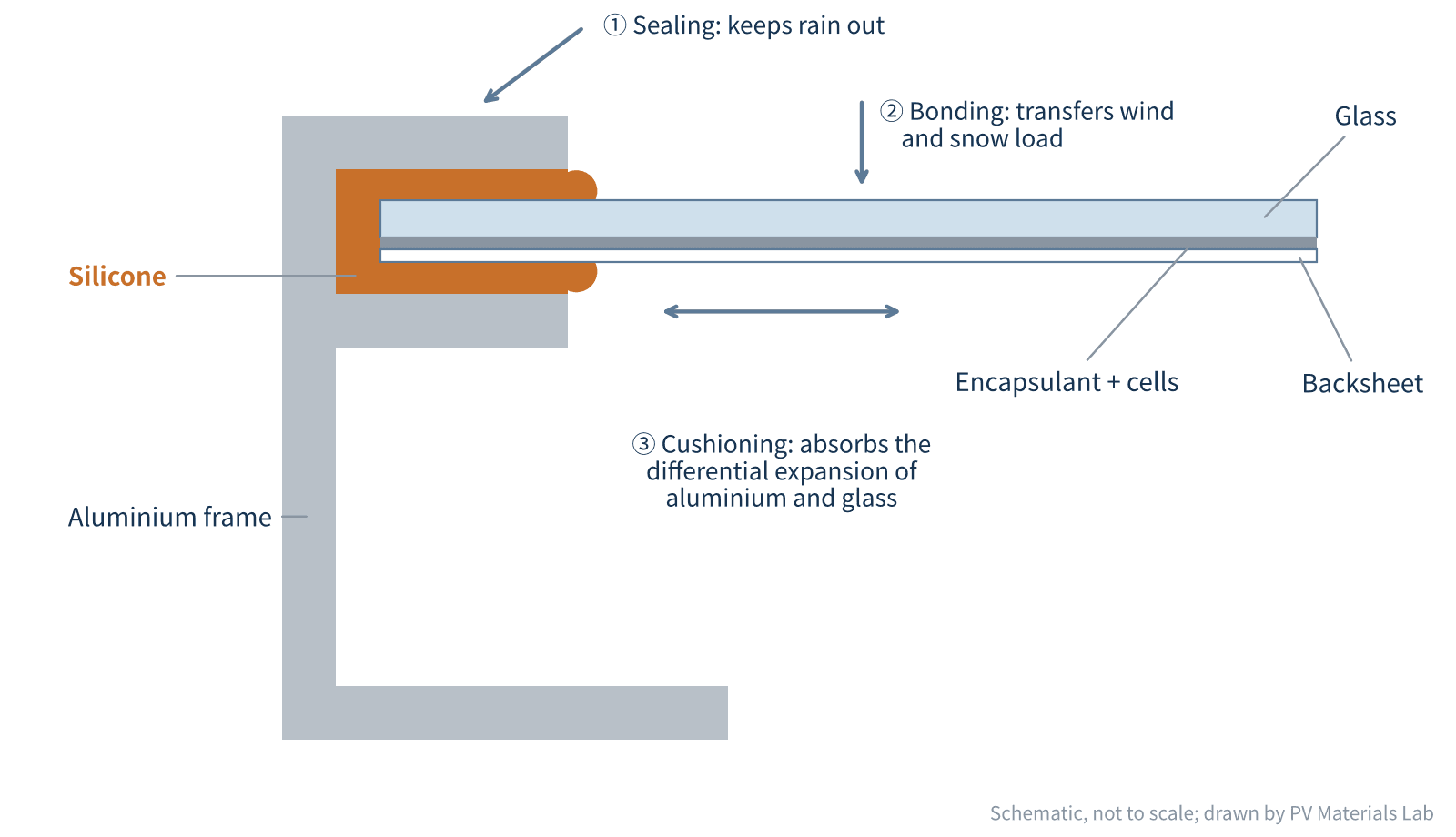
Figure 2 Cross-section of the frame channel: silicone fills the space between channel and laminate
- Sealing: It keeps rain, cleaning water and dust away from the edge, so that liquid water does not sit against the laminate edge and cause edge delamination or wet leakage failures.
- Bonding: It joins laminate and frame into one unit. Wind and snow loads act on the glass, and this bead passes the force to the frame and on to the mounting structure. The static mechanical load test is a test of this bead as much as of the glass and the frame.
- Cushioning: Aluminium and glass expand differently. By our estimate, for a module with a long side of about 2.4 m, the length change of frame and glass differs by roughly 4 mm between -40 °C and 85 °C. Glass and aluminium cannot take up that difference against each other; the elastic layer between them has to absorb it.
One point needs to be clear: silicone stops liquid water but not water vapour. Among common polymers, silicone has a relatively high water vapour transmission rate. The frame sealant is therefore a water seal, not a vapour barrier, and protection of the laminate interior against moisture still depends on the glass, the backsheet and the encapsulant. This is why modules that are extremely sensitive to moisture, such as perovskite modules, use a separate butyl edge seal.
04 Junction box adhesive: holding the box for more than twenty years
The junction box is bonded to the backsheet or rear glass by a bead around its base. It is first of all a structural bond: the box is light, but it has to withstand cable pull, knocks during installation and maintenance, and gravity acting continuously for more than twenty years. MQT 14.1 in IEC 61215-2 checks exactly this: after UV preconditioning, thermal cycling and humidity freeze, a force of 40 N is applied for about 10 s in each direction parallel to the mounting surface and then perpendicular to it, and the box must not be displaced in a way that impairs its insulation.
The second job is sealing. The bead has to be continuous and closed around the opening where the busbars come out. That stops water from creeping in under the box and stops the potting compound, applied in the next step, from leaking out at the bottom.
The difficulty is the variety of surfaces: fluorinated backsheets, transparent backsheets, coated backsheets and the ceramic glaze on rear glass all have very different surface energies, and an adhesive that works on one may fail on another. For this reason the adhesive is never evaluated on its own. The junction box housing, the adhesive and the rear surface are qualified together as a system.
Takeaway: The frame sealant and the junction box adhesive do the same kind of work: bond, seal and give way. That is why both positions usually use the same class of one-part silicone; the differences lie mainly in the substrates and the way the joint is loaded.
05 Potting compound: solid insulation around live parts
Inside the junction box are the busbar solder joints, the bypass diode and the cable terminal, and the scope of IEC 62790 covers system voltages up to 1500 V DC. In a potted junction box, a two-part liquid silicone is mixed and poured to fill the cavity; once cured, all live parts are embedded in a single block of elastomer (Figure 3).
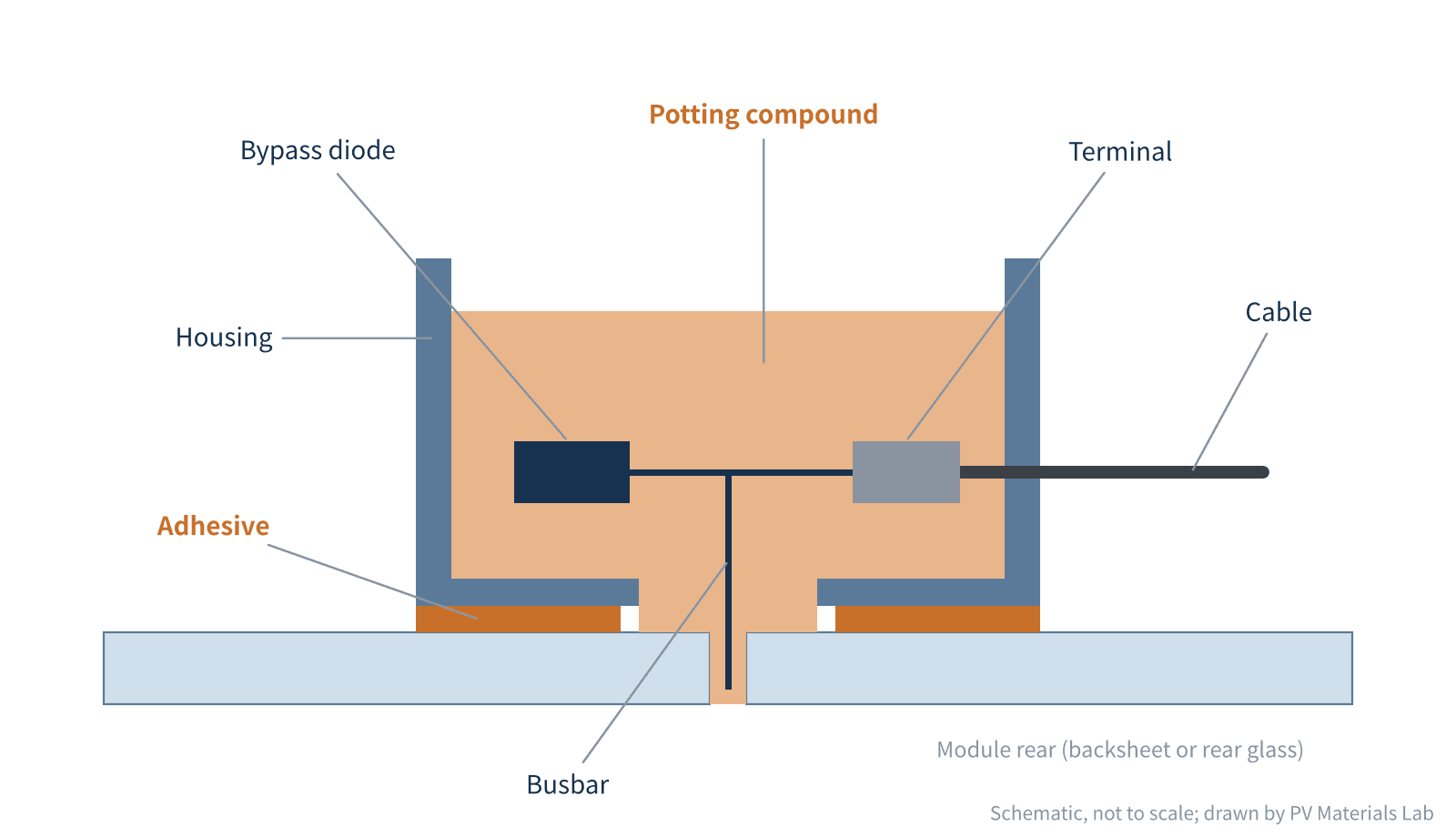
Figure 3 Cross-section of a potted junction box: adhesive under the box, potting compound in the cavity
- Insulation: The space between live parts, and between live parts and the housing, is no longer air and plastic surface but solid insulation, which greatly reduces the risk of leakage and tracking caused by moisture and dirt.
- Moisture and corrosion protection: It keeps condensation and salt mist away from the solder joints and diode leads.
- Heat conduction: When the module is shaded, the bypass diode conducts and heats up. Air is a very poor conductor of heat; the potting compound carries heat to the housing and the rear of the module and helps keep the diode junction temperature under control.
- Flame retardancy: The junction box is the part of a module most prone to overheating and arcing, and potting compounds are normally required to reach a UL 94 V-0 rating.
- Stress relief: The cured compound is soft, so it does not pull on solder joints and leads during thermal cycling.
Why is the potting compound a two-part product? Because the cavity is deep and its opening small. A one-part silicone cures from the surface inwards using moisture from the air, and struggles to cure through at depth; a two-part silicone reacts throughout its volume once mixed. The next article covers this in detail.
06 Why silicone
Many chemistries can seal and bond: polyurethane, epoxy, acrylic and silane-modified polymers among them. PV has settled almost entirely on silicone, and the reason lies in the backbone.
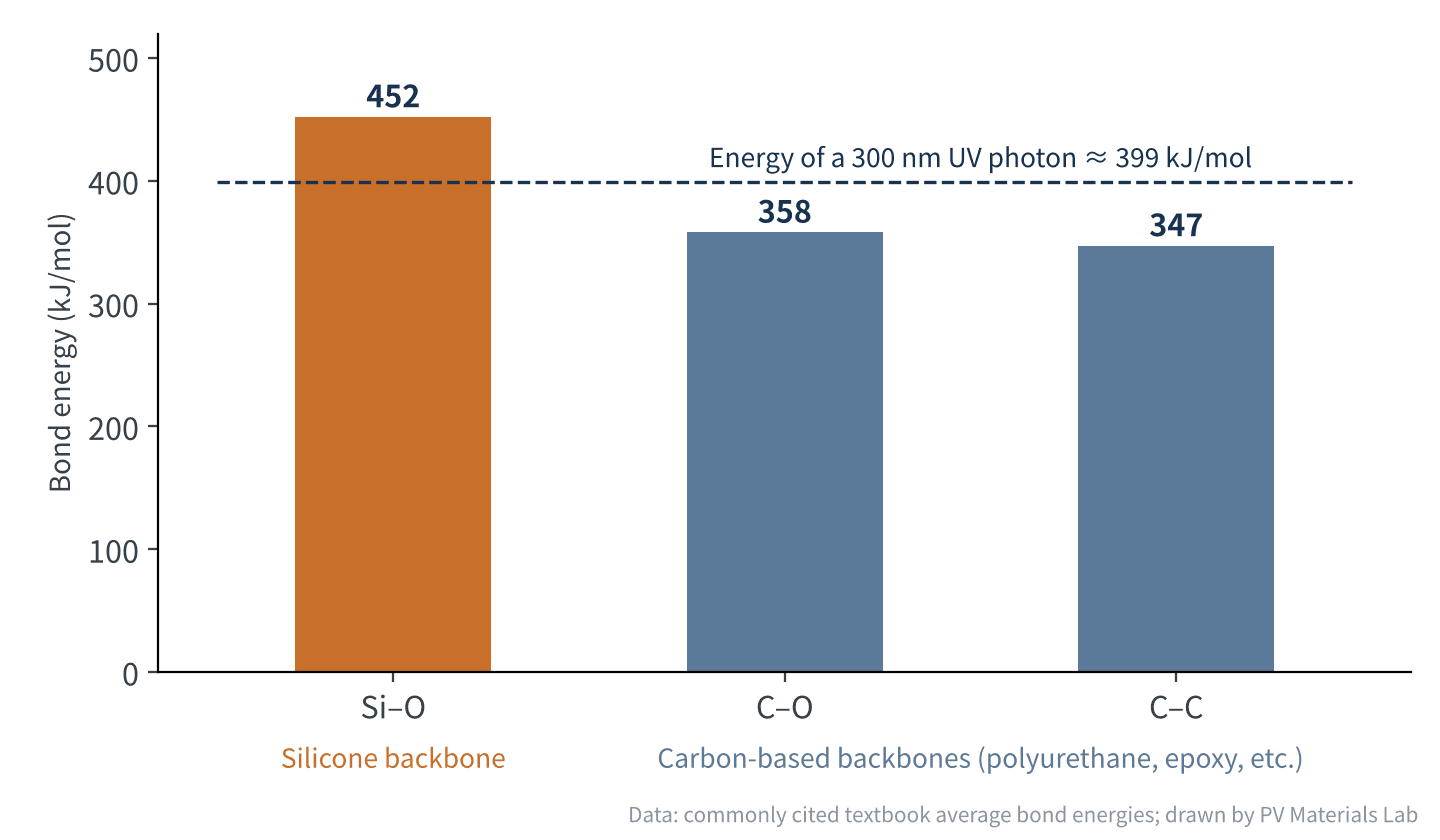
Figure 4 Bond energy of the Si–O bond compared with carbon-based backbone bonds
- UV resistance: The Si–O bond energy is about 452 kJ/mol, higher than C–C (about 347) and C–O (about 358), and higher than the energy of a 300 nm UV photon (about 399 kJ/mol). Sunlight can hardly break the siloxane backbone directly, which is the fundamental reason silicone does not chalk or crack outdoors.
- Elastic over a wide temperature range: The glass transition temperature of polydimethylsiloxane is about -120 °C, far below the -40 °C low-temperature point in module testing, and its high-temperature capability is far above 85 °C. Across the whole -40 °C to 85 °C range its hardness and modulus change very little.
- Hydrophobic and a good insulator: Its surface energy is low, so it repels water naturally; its volume resistivity is high and falls little when damp.
- Adhesion to many substrates: With silane coupling agents it bonds very well to glass and anodised aluminium, and formulations can be tuned for backsheets and plastic housings.
- Process-friendly: It cures at ambient temperature without heating, which suits the cycle time of a module line.
By comparison, polyurethane costs less but is weaker against UV and damp heat, and epoxy is too rigid once cured: it tends to crack under thermal cycling and passes stress on to solder joints. Both are used on modules only in a few specific cases.
Bottom line: The value of silicone is not that one property is outstanding. It is that after more than twenty-five years of cold, heat, UV and damp heat combined, its properties have changed very little.
07 Silicone has weaknesses too
- No vapour barrier: As noted above, it keeps out liquid water only.
- Slow cure: One-part silicone cures with moisture. The surface skins over quickly, but full cure often takes days and depends strongly on workshop temperature and humidity. Handling and stacking of finished modules have to be timed around it.
- Compatibility risks: Small molecules released during cure and residual low-molecular-weight siloxanes can interact with the backsheet, the encapsulant and the junction box plastic. The platinum catalyst in addition-cure potting compounds can also be “poisoned” by substances containing sulphur, phosphorus, nitrogen or tin, so that the compound fails to cure.
- Hard to rework and recycle: Once cured it is a cross-linked elastomer that neither melts nor dissolves. Removing a frame or a junction box is laborious, and the same property makes end-of-life dismantling and recycling harder.
These weaknesses are exactly what the later articles in this series will take up one by one.
08 Final thoughts
Back to the opening question. Silicone guards three places on a module: the frame channel, the underside of the junction box and the junction box cavity. In the first two it has to bond, seal and give way; in the third it has to insulate, keep moisture out, conduct heat and resist flame. Silicone was chosen because its siloxane backbone changes least over twenty-five years outdoors.
But products that are all called “silicone” differ widely: one-part and two-part, condensation-cure and addition-cure, alkoxy and oxime. Their cure mechanisms and suitable positions are very different, and using one in the wrong place is where failures begin. The next article covers the types of silicone and how they cure.
Calculation notes / data basis
- Differential thermal expansion of frame and glass: coefficient of linear expansion about 23×10⁻⁶/K for aluminium alloy and about 9×10⁻⁶/K for soda-lime glass, module long side 2382 mm, temperature range -40 °C to 85 °C (125 K): (23−9)×10⁻⁶×125×2382 ≈ 4.2 mm. This is the free expansion difference accumulated over the full length, ignoring temperature gradients and structural constraint; it is given only to show the order of magnitude.
- Energy of a 300 nm photon: E = N_A·h·c/λ ≈ 119.6/λ(μm) kJ/mol ≈ 399 kJ/mol.
- Bond energies are commonly cited textbook averages and vary slightly between sources (Si–O about 444–460, C–C about 346–348, C–O about 358–360 kJ/mol). The glass transition temperature of polydimethylsiloxane is likewise a commonly cited literature value (about -120 °C to -125 °C).
- The force and duration in MQT 14.1 are taken from reference [4], which summarises IEC 61215-2:2021; reference [5] gives the current edition of GB/T 29595 as 2023. Please check both against the standards themselves before formal citation.
References
- GB/T 29595. Sealant material in terrestrial photovoltaic (PV) modules – Silicone sealant (Chinese national standard).
- IEC 61215-2:2021. Terrestrial photovoltaic (PV) modules – Design qualification and type approval – Part 2: Test procedures (MQT 14.1 Retention of junction box on mounting surface).
- IEC 62790:2020. Junction boxes for photovoltaic modules – Safety requirements and tests.
- Sinovoltaics. IEC 61215 MQT 14: Robustness of Terminations Test for Solar Modules. https://sinovoltaics.com/learning-center/testing/iec-61215-mqt-14-robustness-of-terminations-test-for-solar-modules/
- Adhesion (粘接, in Chinese), 2025, 52(1): 12-15 (silicone structural sealant for PV modules, GB/T 29595-2023 and ETAG 002). DOI: 10.3969/j.issn.1001-5922.2025.01.004
PV Materials Lab
https://pvmaterialslab.com
PV Materials Lab
A PV R&D and technical team with 10+ years of experience | In-depth technical knowledge sharing
Materials · Reliability · Failure Analysis · Standards & Certification · Products · Processes
Exploring AI + PV — collaboration welcome
Disclaimer:
- Original content reflects the authors' personal views only, is for reference, and does not constitute investment advice.
- Reposted and cited content is credited to its source, with respect for original work.
- Some content is AI-assisted (chart generation, data retrieval, concept explanations, etc.); the core framework and key content are written by our technical team and reviewed by humans.
- For any inaccuracy or infringement, please leave a message or contact us.