
A 6GW AI Campus with 24GWh of Storage: Data Centers Are Bringing Their Own Power Plants
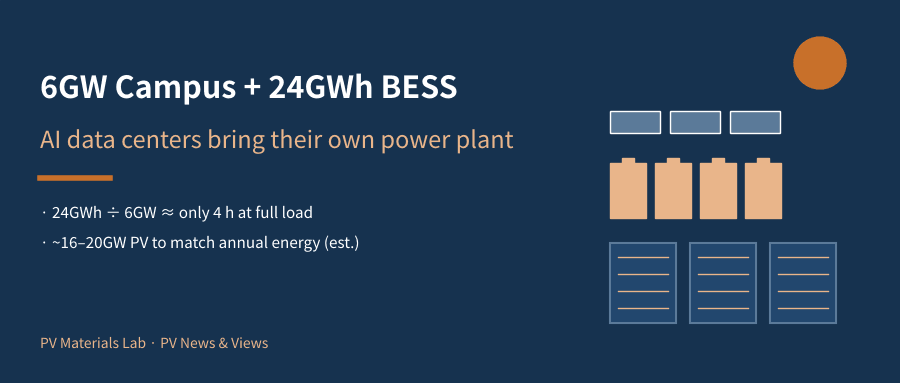
According to Data Center Dynamics, SpaceXAI, through an affiliated company, has applied to Cochise County, Arizona, to build up to nine data center buildings in four phases on about 747 acres. At full load the campus could require around 6GW, and the plan includes a 24GWh battery energy storage system to limit the impact on the state grid. A zoning hearing is set for December 9. Our math: 24GWh covers only about 4 hours at full load, so storage here is a buffer for peak shaving, not an off-grid solution. Covering the campus's annual energy with PV alone would take well over ten gigawatts. The project is still at the application stage and faces visible community opposition.
For the past two years, "AI consumes a lot of power" has been an abstract statement. This week, one news item put concrete numbers on it: a single compute campus, about 6GW at full load, with its own 24GWh battery storage. For PV and storage professionals, what matters here is not Elon Musk, but the power math behind it.
01 What happened
Based on Data Center Dynamics (DCD) reporting on November 6 and Chinese media accounts of a local community meeting, the key points are as follows (all are figures claimed in the application or in reports):
- Applicant: SpaceXAI (the AI business formed after xAI merged into SpaceX), through its affiliate Tombstone Resources, applied to Cochise County, Arizona, for a special development permit.
- Scale: About 747 acres (roughly 3 km²), four phases, up to nine data center buildings.
- Power: Could require about 6GW at full load.
- Storage: A planned 24GWh battery energy storage system, which reports say is intended to keep the campus's power use from impacting Arizona's grid.
- Status: A zoning hearing is set for December 9; local residents have reportedly started a petition against it.
Note: we were unable to open the DCD article directly. The figures above rely on secondhand media reports. The project is only an application; it is neither approved nor built.
02 How big is 24GWh? Four hours at full load
24GWh is a very large number in the storage industry; single projects of this size are uncommon. But set against a 6GW load, the math is simple: 24GWh ÷ 6GW = 4 hours.
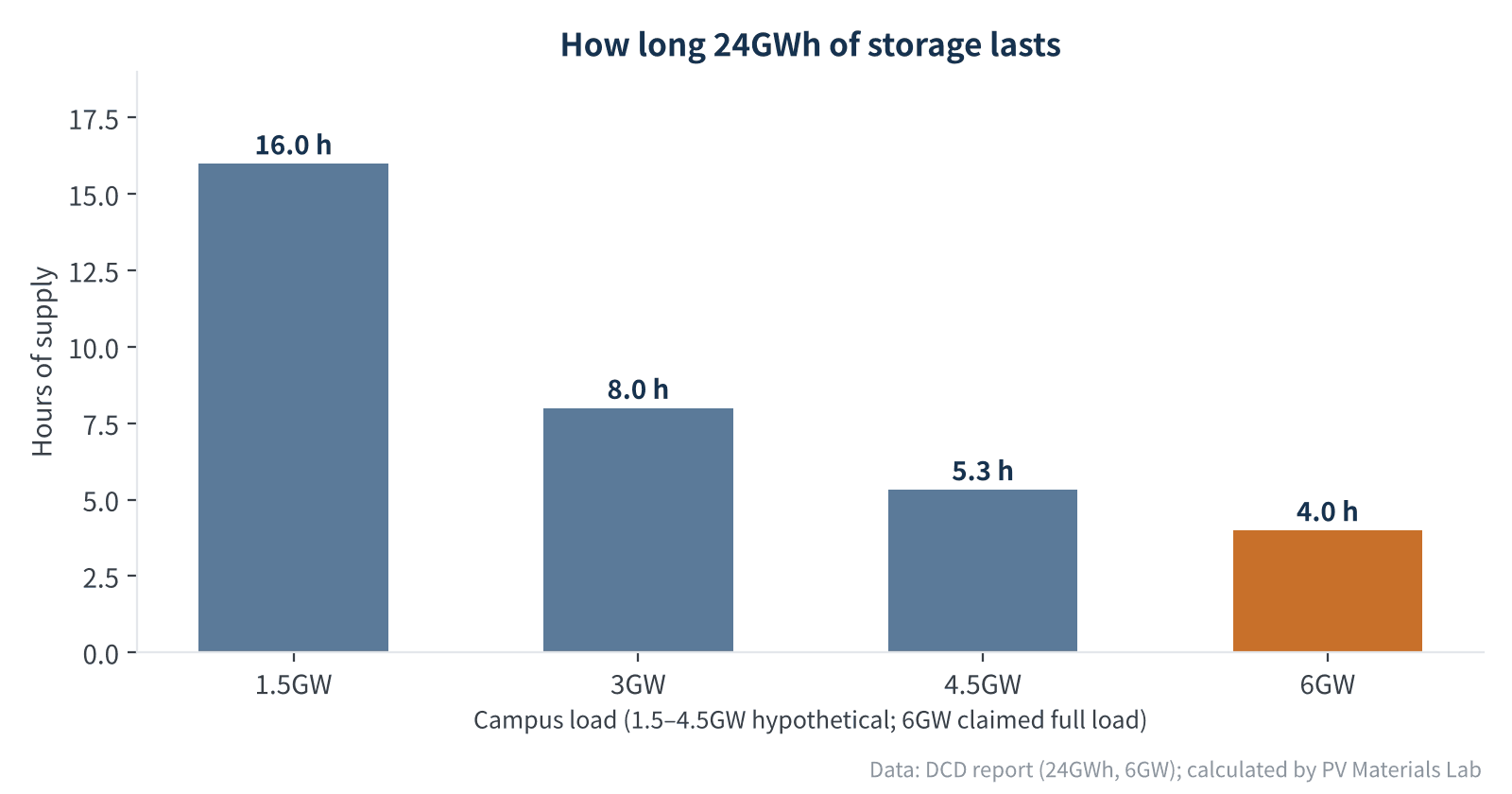
Fig. 1 Hours of supply from 24GWh of storage at different campus loads
In other words, this storage system cannot let the campus run off-grid. Its more likely roles are:
- Peak shaving: Supplying the campus from batteries during the grid's evening peak, reducing draw when the grid is most stressed.
- Load smoothing: AI training loads swing sharply as jobs start and stop; batteries can absorb these fast changes and soften the impact on the grid.
- Backup power: Replacing all or part of conventional diesel backup for short-duration supply.
- PV time-shifting: If PV is built nearby, batteries can move surplus daytime solar into the evening.
Takeaway: 24GWh is a big order for the storage industry, but for a 6GW load it is only a four-hour cushion. It addresses grid friendliness, not where the power comes from.
03 Where will 6GW come from? How much can PV supply
Where the power comes from is the question PV professionals should care about. A rough estimate: assuming an average load factor of 70%–90%, annual consumption would be about 37–47TWh. Arizona has excellent solar resources; at an assumed capacity factor of about 27% for utility-scale plants, matching that annual energy with PV alone would require roughly 16–20GW of PV.
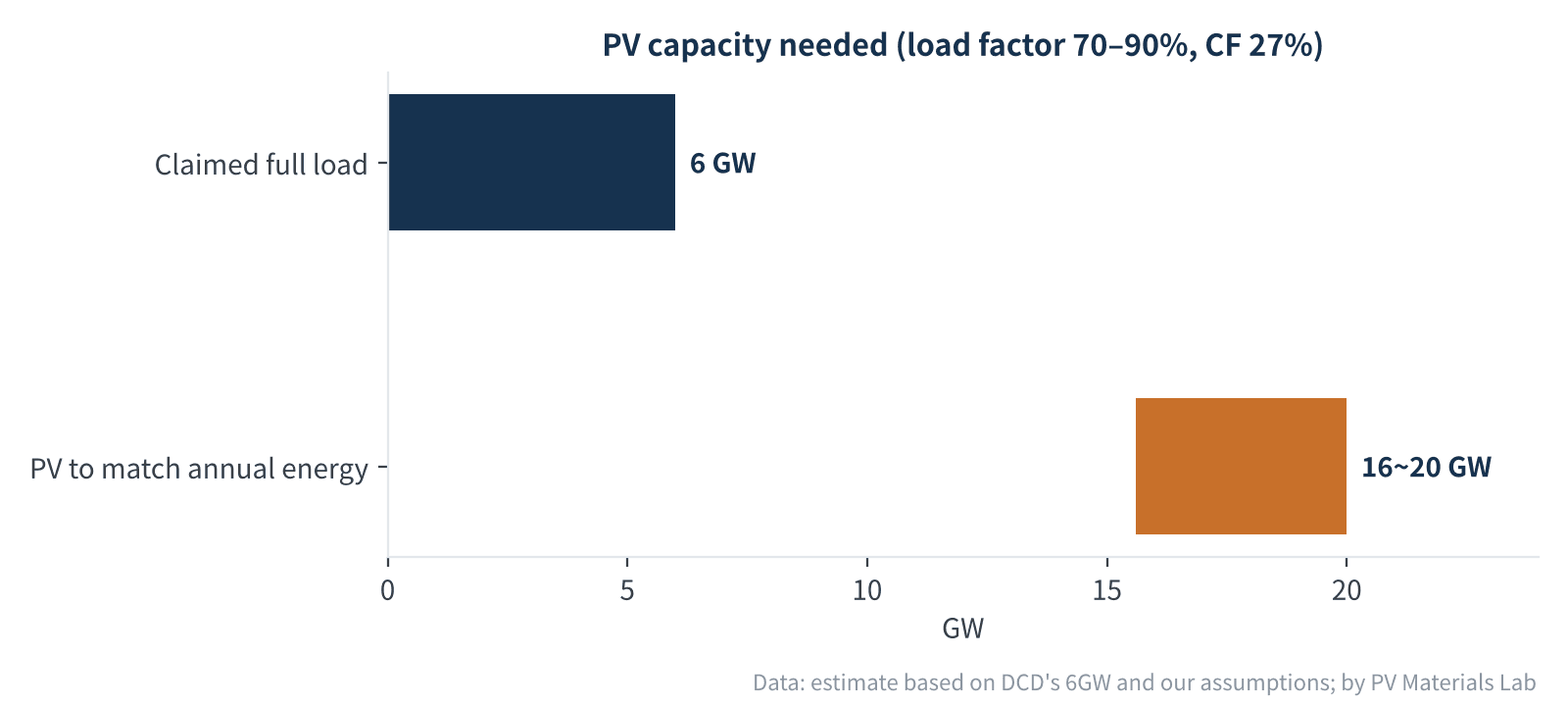
Fig. 2 PV capacity needed to match annual consumption (our estimate)
Using a rule of thumb of 4–5 acres per MW for utility-scale PV, 16GW would need about 60,000–80,000 acres, more than a hundred times the campus site itself. Even in the sunniest regions, a GW-scale AI campus cannot rely on on-site solar; it depends on the grid, a mix of sources, and regional renewable development.
There is also a timing issue: PV only generates during the day. Sustaining 6GW through a night of more than ten hours would take over 80GWh of storage, far beyond 24GWh. So PV plus storage is more realistically one part of the mix, working alongside grid purchases and gas generation.
Notably, DCD has reported that SpaceXAI's Colossus 1 and Colossus 2 data centers in Memphis are powered by gas turbines, and its gas plant in Mississippi drew controversy over permitting. What power mix the Arizona project will use is not yet public; the December hearing may reveal more.
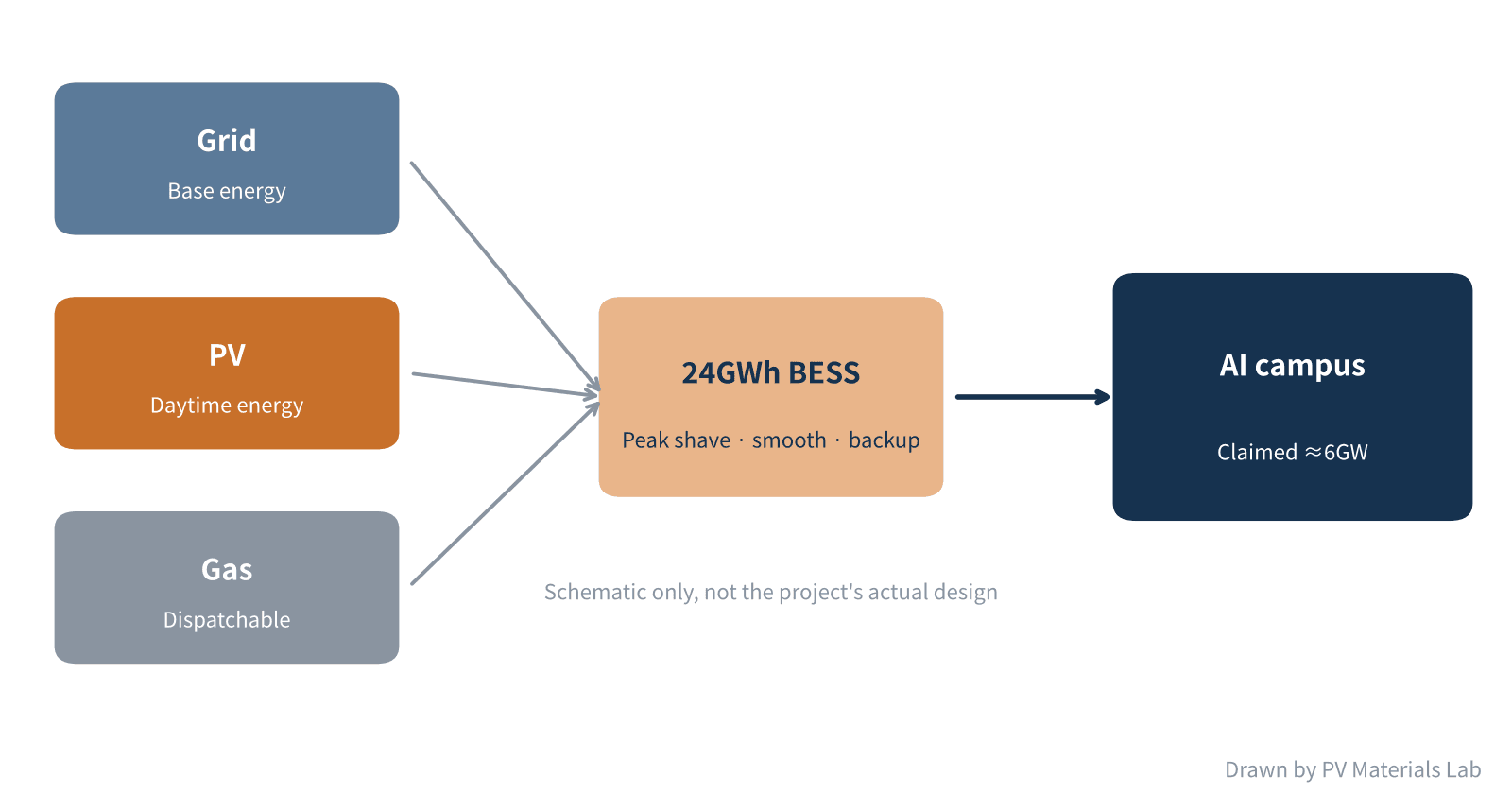
Fig. 3 Typical power-supply mix for a GW-scale AI campus (schematic)
04 Why Arizona? Why bring its own storage
Public information points to several factors:
- Grid pressure: A 6GW load is a huge increment for any state grid. Large on-site storage is one way to show regulators and communities that the project won't crowd out residential supply, and a bargaining chip for interconnection.
- Tighter local permitting: In March 2026, Cochise County amended its zoning rules to define data centers as a new land use and require every data center to obtain a Special Use Authorization, with no approval by right.
- Community resistance: Local media reported that the county's planning commission narrowly recommended a 120-day pause on new data center applications. In August, a solar plant expansion in the county was rejected, with some residents fearing solar-plus-storage expansions were a precursor to data centers.
That last point is a warning for the PV industry: in parts of the US, solar and storage projects are increasingly seen as tied to data centers, and community concerns about data centers may spill over into solar and storage permitting.
05 Implications for PV and storage professionals
- A new source of storage demand: AI data centers are shifting from pure power consumers to storage buyers. GWh-scale storage requirements are an incremental market for cells, PCS and system integration.
- Different product requirements: Data center applications care about response speed, cycle life, fire safety and availability, not just levelized cost. That changes how storage systems are designed and validated for reliability.
- PV is energy, storage is time: Campus-level green power combines remote PV energy with local storage duration. Module cost reduction and efficiency gains remain the foundation, but system-level integration matters more and more.
- Front-load permitting risk: The bigger the project, the greater the community and permitting uncertainty. There is often a wide gap between claimed scale and what actually gets built.
Bottom line: AI data centers are a real source of new demand for PV and storage, but what they need is firm power. Only when PV and storage work together, and pass the tests of reliability and permitting, can the industry truly capture this opportunity.
06 Our view
Value: this story turns "AI power demand" from an abstract idea into an engineering problem you can calculate. A 6GW load, 24GWh of storage and four phases make it easy to see the impact of data centers on the grid and the role storage plays.
Limitations: every number is a claimed figure from an application or a report. Whether all 6GW will be built, how the phases will proceed, what storage technology will be used, and where the power will come from are all still unanswered. Community opposition and stricter county permitting add further uncertainty.
China context: China's "East Data, West Computing" program steers compute toward energy-rich western regions, and recent policies such as direct green-power supply let renewable projects serve loads more directly. The idea is similar to the Arizona project: put compute close to energy and give the load its own flexibility. For Chinese PV and storage companies, storage for overseas data centers is a direction worth tracking.
07 Final thoughts
"The end of AI is energy" has been said many times. But at the level of a single project, the real difficulty is not how much power is needed, but when it is needed, where it comes from, and whether the grid can take it.
The 24GWh of storage offers a first answer: soften the impact. The longer-term question of supply will be a long contest among PV, storage, the grid and gas. We will keep following the December 9 hearing.
Calculation notes / data basis
- Original article not retrieved: the DCD article could not be opened due to site restrictions; project figures rely on secondhand media reports and are all claimed/application values.
- Storage duration: 24GWh ÷ 6GW = 4h; the 1.5/3/4.5GW loads in Fig. 1 are hypothetical scenarios, not reported figures.
- Annual consumption: 6GW × 8,760h × load factor 70%–90% ≈ 37–47TWh (load factor is our assumption).
- PV capacity: annual consumption ÷ (8,760h × 27% capacity factor) ≈ 16–20GW; 27% is an assumed value for utility-scale PV in Arizona, excluding losses and curtailment.
- PV land: at 4–5 acres/MW, 16GW ≈ 64,000–80,000 acres; rough estimate.
- Overnight storage: about 14 hours at 6GW full load ≈ 84GWh, for illustrating magnitude only.
References
- Data Center Dynamics. SpaceXAI plans data center campus in Cochise County, Arizona (24GWh BESS, up to 6GW), 2026-11-06. https://www.datacenterdynamics.com/en/news/spacexai-data-center-arizona-cochise-county-elon-musk/
- Data Center Dynamics. SpaceXAI launching two additional data center campuses in Mississippi to further expand Colossus 2, 2026. https://datacenterdynamics.com/en/news/spacexai-launching-two-additional-data-center-campuses-in-mississippi-to-further-expand-colossus-2
- 财联社. SpaceX拟在得州新建数据中心 规模或超孟菲斯基础设施, 2026-07-23. https://www.cls.cn/detail/2435173
- Cochise County Planning and Zoning Commission. Docket R26-01 Data Centers, Staff Presentation, 2026-03-11. https://public.destinyhosted.com/cochidocs/2026/PZC/20260311_3262/9249_R26-01_Staff_Presentation.pdf
- KOLD 13 News. Solar field expansion resoundingly rejected in Cochise County, 2026-08-13. https://www.kold.com/2026/08/13/solar-field-expansion-resoundingly-rejected-cochise-county/
- Sierra Vista Herald/Review. P&Z panel narrowly backs data center moratorium after public opposition. https://www.myheraldreview.com/news/cochise_county/p-z-panel-narrowly-backs-data-center-moratorium-after-public-opposition/article_6d64c029-1ec9-49e4-8995-9741069167db.html
PV Materials Lab
https://pvmaterialslab.com
PV Materials Lab
A PV R&D and technical team with 10+ years of experience | In-depth technical knowledge sharing
Materials · Reliability · Failure Analysis · Standards & Certification · Products · Processes
Exploring AI + PV — collaboration welcome
Disclaimer:
- Original content reflects the authors' personal views only, is for reference, and does not constitute investment advice.
- Reposted and cited content is credited to its source, with respect for original work.
- Some content is AI-assisted (chart generation, data retrieval, concept explanations, etc.); the core framework and key content are written by our technical team and reviewed by humans.
- For any inaccuracy or infringement, please leave a message or contact us.