
One Sheet of Glass, Four Roles: What PV Glass Does in a Module
In brief
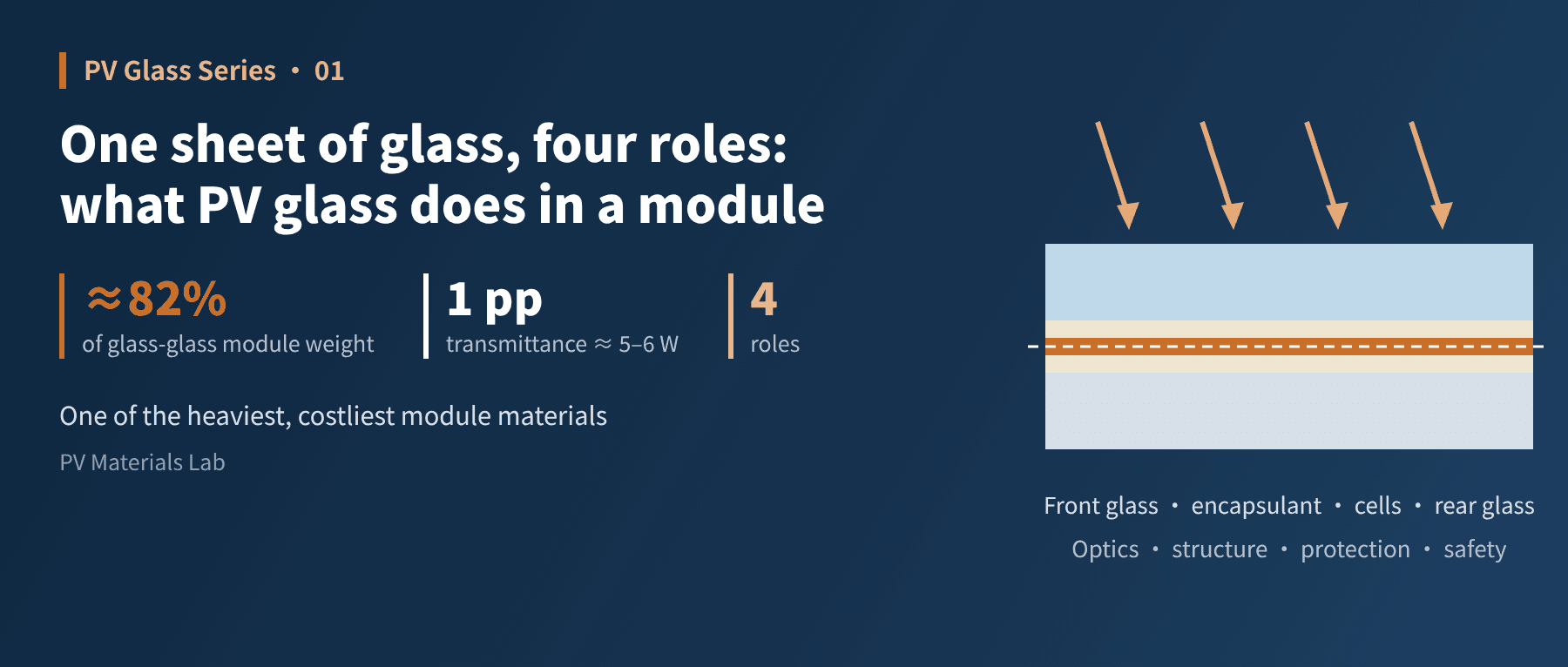
PV glass is often treated as the "transparent cover" on top of a module, but it actually plays four roles at once: optical window, structural backbone, protective barrier, and insulation and safety. In the glass-glass era, glass accounts for about 80% of module weight and is one of the materials with the largest share of module cost. As the first article in our PV glass series, this piece gives a systematic look at where this glass sits in a module and how much it matters.
When people think of the key materials in a module, cells usually come first, followed by encapsulant and ribbon. PV glass seems the most "ordinary": a transparent sheet on top. But take a glass-glass module apart and weigh it, and you will find that glass makes up more than 80% of its weight. Look through module failure statistics, and breakage, transmittance loss and coating peel-off are perennial entries. In this article we start by making clear what PV glass actually does in a module.
01The heaviest material in the module
First, position. A mainstream bifacial glass-glass module consists, from top to bottom, of front glass, front encapsulant, cells and ribbons, rear encapsulant and rear glass, finished around the edges with a frame and sealant. A glass-backsheet module replaces the rear glass with a polymer backsheet.
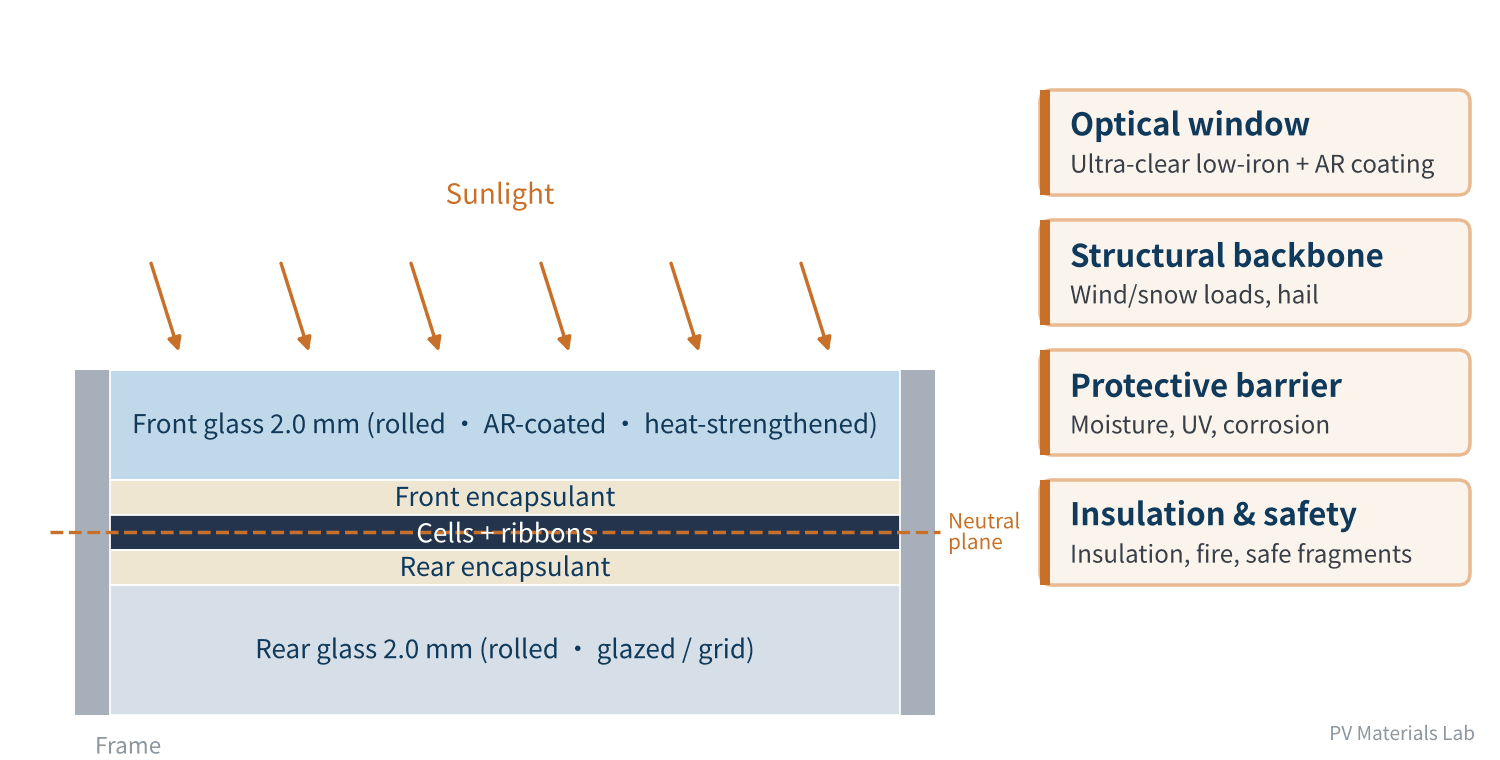
Figure 1. Cross-section of a glass-glass module and the four roles of PV glass (schematic)
Next, weight. Taking the common 2382 × 1134 mm format as an example, we did a rough calculation: in a 3.2 mm glass-backsheet module, the glass weighs about 21.6 kg, more than 70% of the module; in a 2.0 + 2.0 mm glass-glass module, the two sheets together weigh about 27 kg, and the share rises to over 80%.
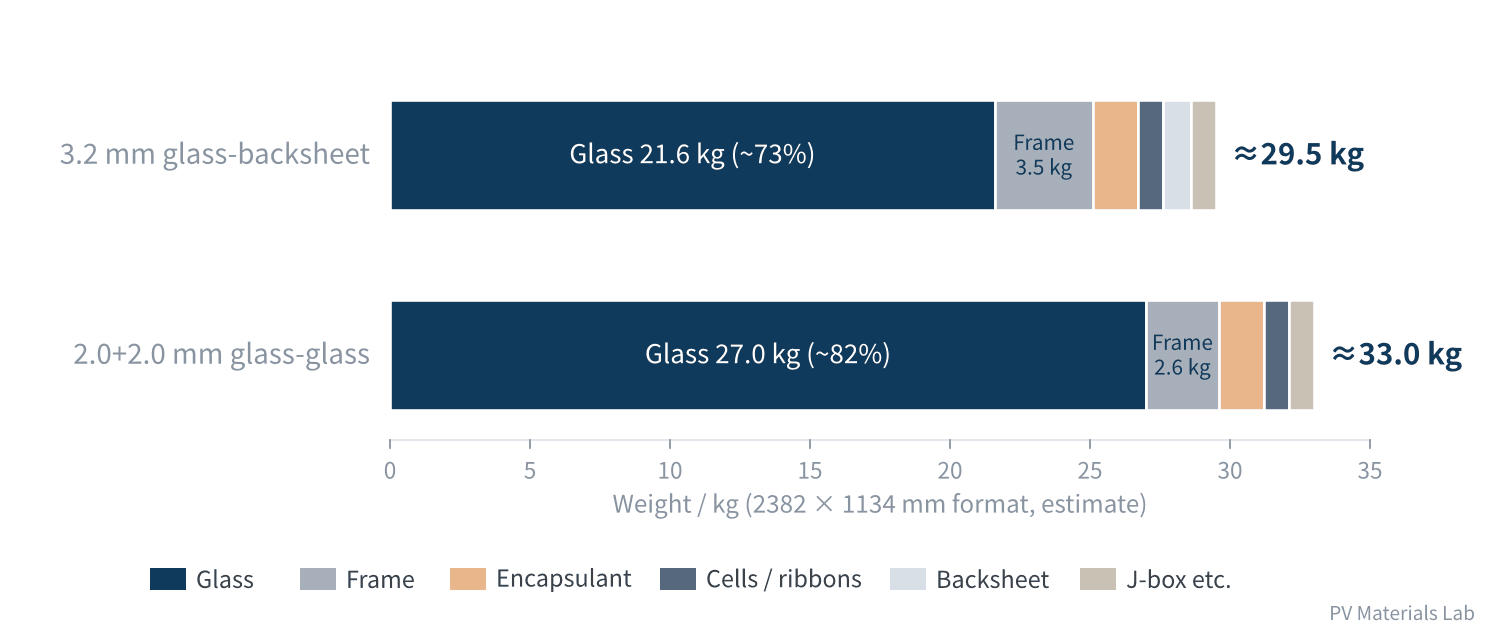
Figure 2. Weight breakdown of glass-backsheet and glass-glass modules (estimate)
Cost tells the same story. Back in the glass-backsheet era, analysts estimated PV glass at about 6–7% of module cost. Today, with module prices far lower, glass weighs even more heavily: based on mid-October 2026 market prices (about CNY 11.4/m² for 2.0 mm double-layer AR-coated glass and about CNY 17.5/m² for 3.2 mm), the two sheets in a glass-glass module come to roughly CNY 0.10/W, more than 10% of the module price, while the single 3.2 mm sheet in a glass-backsheet module is about CNY 0.075/W, also around 10%. Glass is now one of the weightiest items among non-silicon costs.
Glass is no "supporting actor" in a module: it is one of the heaviest materials with one of the largest cost shares, and when it fails, the whole module is usually scrapped.
02Role one: optical window
All the light that generates power must first pass through the front glass. Every extra 1% of light the glass blocks costs roughly 1% of cell current, and module power drops by about 1% too. For a module of over 600 W, one percentage point of transmittance is five or six watts. So PV glass does three things optically:
- Low iron: iron in ordinary architectural glass absorbs light, especially in the near infrared, which is exactly where crystalline silicon cells respond best. PV glass uses a low-iron "ultra-clear" formula, and industry standards require Fe₂O₃ content of no more than 0.015%, an order of magnitude lower than ordinary float glass.
- Patterning: PV glass is mostly made by rolling, with a fine pattern on one side. This improves adhesion to the encapsulant and scatters light to reduce reflection losses.
- Anti-reflective coating: the glass–air interface reflects about 4% of the light. A porous silica-based anti-reflective (AR) coating on the air side sharply reduces this reflection and raises transmittance by about another 2 percentage points.
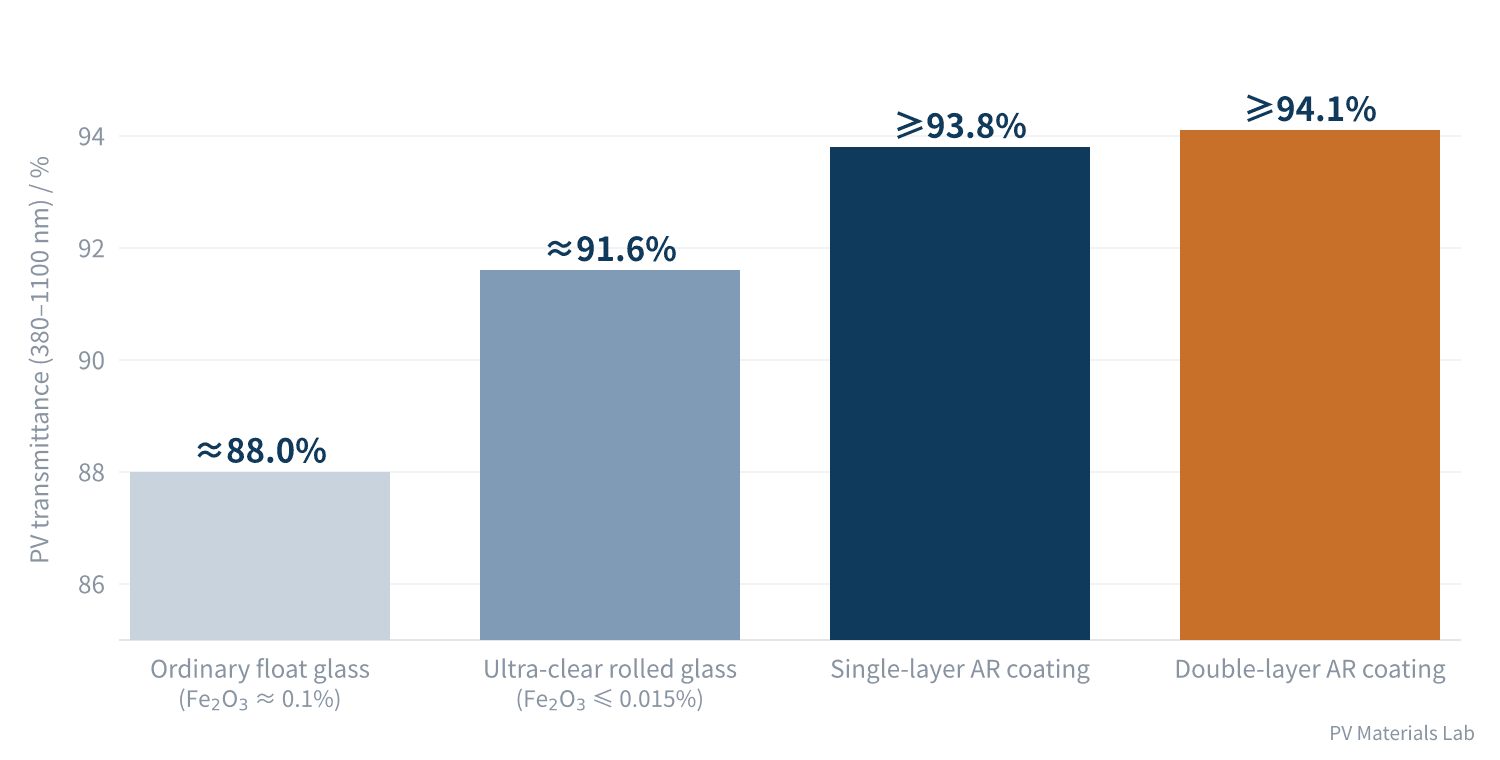
Figure 3. PV transmittance of different glass types (typical values and standard thresholds)
Under T/CPIA 0028.1—2024, the China Photovoltaic Industry Association standard published and implemented in December 2024, the PV transmittance of front AR-coated glass over 380–1100 nm must be at least 93.8% for a single-layer coating and at least 94.1% for a double-layer coating. Those few tenths of a percentage point translate into real power bins at the module level.
Optical performance also has a durability side: the coating has to withstand sand abrasion, acid rain, salt mist and damp heat, or transmittance will quietly drop after a few years in the field. The standard therefore puts coated glass through a full set of tests, including washing, acid resistance, salt mist, thermal cycling, humidity freeze, damp heat, UV, sand and dust, and PCT, and average transmittance loss after each test must not exceed 1%.
03Role two: structural backbone
Cells are thin and brittle and cannot withstand wind, snow or hail on their own. A module's mechanical strength comes mainly from the glass. The static loads common in certification, 5400 Pa on the front and 2400 Pa on the back, and the hail test with 25 mm ice balls at 23 m/s, test the glass first of all.
To make glass tougher, PV glass is fully tempered or heat-strengthened: it is heated close to its softening point and then quenched, creating a layer of compressive stress at the surface. A crack must first "cancel out" this compressive layer before it can grow, so strength rises several-fold. Thick glass can be fully tempered, but thin glass such as 2.0 mm cools quickly and it is hard to build up a temperature difference between surface and core, so it can usually only be heat-strengthened. This is a core challenge for thinner glass, which we will cover in the process articles.
The glass-glass structure has another often-overlooked benefit: the neutral plane. When a module bends under load, the upper surface is in compression and the lower surface in tension, with a "neutral plane" in between that sees neither. In a glass-backsheet module the cells sit below the glass, in the tension zone; in a glass-glass module the build is symmetric and the cells lie close to the neutral plane, seeing almost no tension or compression when bent, which clearly reduces the risk of microcracks.
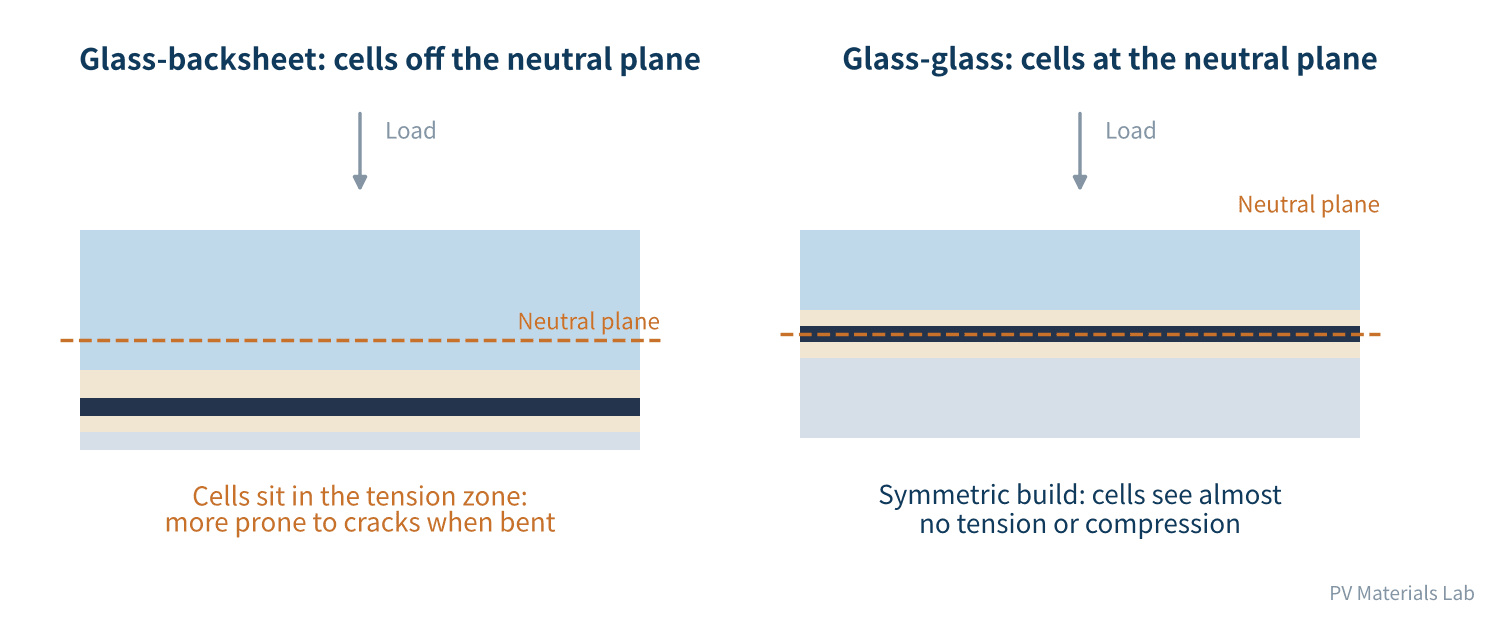
Figure 4. Position of the cells relative to the neutral plane in glass-backsheet and glass-glass structures (schematic)
For a module, glass is the "backbone". Thinner glass cuts cost and weight, but every reduction in thickness has to be made up in structural margin through process, frame and mounting.
04Roles three and four: protective barrier, insulation and safety
What cells and ribbons fear most are moisture, oxygen and corrosive substances. Glass is practically impermeable to water vapour, making it the best barrier material in a module. A glass-backsheet module relies on a polymer backsheet for rear protection, and the backsheet still lets some water vapour through. A glass-glass module has glass on both sides, so moisture can only creep in slowly from the edges. This is a major reason glass-glass modules are favoured in damp-heat, coastal and floating installations.
As for UV, ordinary soda-lime glass absorbs the shorter-wavelength part of the ultraviolet, but most UV-A still passes through to the encapsulant and cells. A module's UV resistance is therefore determined jointly by the glass, the encapsulant and the cells, not by the glass alone.
On safety, glass plays several roles at once:
- Electrical insulation: glass is a good insulator. Together with encapsulant and backsheet, it isolates the live cell strings from the outside and keeps the module safe at 1500 V system voltage.
- Fire: glass does not burn. With glass on both sides, glass-glass modules usually perform better in fire than polymer-backsheet structures, an advantage on rooftops and similar sites.
- Controlled fragments: fully tempered glass breaks into small granules, reducing the risk of cuts, and the standard sets clear requirements for fragment size. Heat-strengthened glass breaks with fewer cracks, and the fragments stay stuck to the encapsulant rather than falling apart.
Glass does have "side effects", of course. Sodium ions in soda-lime glass migrate towards the cell surface under high voltage and humidity, one of the main causes of PID (potential-induced degradation), which we covered in our PID series. Leakage paths formed on the glass surface in damp conditions are also closely linked to PID.
05Reading the "health check" of a PV glass sheet
Translating these roles into specific indicators, a qualified sheet of front coated glass has to pass roughly the following tests. Values are from T/CPIA 0028.1—2024, using the two mainstream thicknesses of 2.0 mm and 3.2 mm as examples:
| Role | Key indicator | 2.0 mm | 3.2 mm |
|---|---|---|---|
| Optical window | Iron content (Fe₂O₃) | ≤0.015% | ≤0.015% |
| Optical window | PV transmittance (single / double AR layer) | ≥93.8% / ≥94.1% | ≥93.8% / ≥94.1% |
| Structural backbone | Ball drop (no breakage from 1 m) | 227 g (heat-strengthened) | 1040 g (fully tempered) |
| Structural backbone | Mean surface stress | ≥65 MPa | ≥95 MPa |
| Structural backbone | Mean bending strength | ≥140 MPa | ≥145 MPa |
| Structural backbone | Bow | ≤0.2% | ≤0.2% |
| Protection & durability | Mean transmittance loss after each environmental test | ≤1% | ≤1% |
Table 1. Key indicators for front AR-coated glass (T/CPIA 0028.1—2024)
As the table shows, 2.0 mm glass has clearly lower requirements than 3.2 mm for impact, surface stress and bending strength. Thin glass has less strength margin, which is the background to frequent breakage problems after glass-glass modules moved to thinner glass, and to the industry's ongoing debate over glass strength standards.
06Final thoughts
Looking back, PV glass plays four roles in a module at once: an optical window that lets in as much light as possible, a structural backbone that withstands wind, snow and hail, a protective barrier that keeps out moisture and corrosion, and a safety baseline for insulation and fire. It is not a passive cover sheet but a structural and functional component that determines a module's 25–30-year life.
Precisely because it plays so many roles, every change to PV glass, such as thinner glass, a new coating or glazing on the rear, is a rebalancing between these roles. Once you understand "what it has to do", you have a single yardstick for looking at the various glass types and process routes later on.
PV glass is one of the heaviest module materials with one of the largest cost shares, and a structural and functional component that governs both energy yield and lifetime.
In the next article we will use one figure to explain how PV glass is classified: rolled versus float, fully tempered versus heat-strengthened, coated versus glazed, and the logic behind the evolution through 3.2, 2.0 and 1.6 mm thicknesses. Stay tuned. We would be glad to hear from you.
References
- China Photovoltaic Industry Association: T/CPIA 0028.1—2024 Glass for photovoltaic modules — Part 1: Front plate anti-reflective coated glass (published 2024-12-15, implemented 2024-12-30), https://www.ttbz.org.cn/Home/PdfFileStreamGet/c3QsMTM5NzQ4
- GB/T 30984.1—2015 Glass for solar energy — Part 1: Ultra-clear patterned glass
- IEC 61215-2:2021, Terrestrial photovoltaic (PV) modules — Design qualification and type approval — Part 2: Test procedures
- Qianzhan Industry Research Institute: Analysis of China's PV glass market in 2018, 2019
- Sina Finance (SMM data): Glass prices stabilised in October; what to expect in November, 2026-10-22, https://finance.sina.com.cn/roll/2026-10-22/doc-iniwavxm5908240.shtml
- pv magazine USA: China solar module prices steady as proposed price floors meet skepticism, 2026-10-23, https://pv-magazine-usa.com/2026/10/23/china-solar-module-prices-steady-as-proposed-price-floors-meet-skepticism/
https://pvmaterialslab.com
A PV R&D and technical team with 10+ years of experience | In-depth technical knowledge sharing
Materials · Reliability · Failure Analysis · Standards & Certification · Products · Processes
Exploring AI + PV — collaboration welcome
Disclaimer:
1. Original content reflects the authors' personal views only, is for reference, and does not constitute investment advice.
2. Reposted and cited content is credited to its source, with respect for original work.
3. Some content is AI-assisted (chart generation, data retrieval, concept explanations, etc.); the core framework and key content are written by our technical team and reviewed by humans.
4. For any inaccuracy or infringement, please leave a message or contact us.